Booking.com

Showing posts with label japan. Show all posts

Tuesday, November 24, 2026

July 24th: Mt Kurodake Out and Back

 I was hoping to do the Kurodake Loop from Suonkyo Onsen. When you make a reservation this far in advance, you’re betting on weather, and to make sure we had a better chance of good weather, I’d booked Hotel Kumoi for two nights. To put it pretty mildly, I lost that bet. Both the 24th and 25th were projected to be rainy and cloudy. The 25th was going to be worse than the 24th, so we left as early as possible from Biei to drive to the Kurodake Ropeway in the hopes that we could get some hiking done.

The drive to Suonkyo hot springs was easy, relatively untraffic’k and we did not get a hint of rain at all. At the bottom of the roadway, we looked up the mountain and we could see clouds crowning the top, but the top station of the ropeway looked clear, and on the TV monitors we could see that while it was cloudy it wasn’t raining. That made the ropeway worth a shot.

Boen threw a temper tantrum and refused to even get onto the Ropeway. We hadn’t bought tickets yet, so we gave him some cash and told him to use his phone to find a lunch place if he got hungry. The Ropeway ran about every 20 minutes, giving us time to fill up water bottles, get out the hiking sticks, and rig the camera. At the top of the ropeway, we had to walk to the chairlift to get us to the trail to the top of Kurodake. This chairlift was an unprotected chairlift, without even safety bars, but it felt safe because it was never very far off the ground. Visibility was very limited, so I mentally adjusted to the idea that while we could hiked to the top of Kurodake summit, we were unlikely to be motivated to go any further, and unless we got very lucky and the clouds were low we were likely to get near whiteout conditions.

Indeed, once we got to the top of the chairlift and signed in at the registration book, the outlook got bleaker. As a workout the hike was fine, going steeply up. If you were looking for an aerobic workout, the altitude combined with the trail would make you sweat as much as you like no matter the weather. There were still bugs, but they weren’t dense or super annoying. Despite the rain the previous night, the trail wasn’t muddy at all. What was completely missing was views. You were just looking at native vegetation all the way up, and it wasn’t until 200m from the top that we started seeing flowers.

At the summit, there were lots of people, but no views. Pretty much the only picture you could take was of the summit sign. There was a mountain hut a couple of km off to one side, but in white out conditions it’s just not very motivating, so we hiked all the way back down. We would meet European visitors in Japan who would talk about how good the hiking was but when we asked them about the views the most someone would say is: “It’s still a good hike even if you see nothing.” If I had access to the Alps there would be no way I would consider Japan good hiking.

Hiking back down, we saw that signs for the Amaryo Waterfall viewpoint. The sign claimed it to be a 15 minute one way trip, and we were there so we might as well go. We took the walk and at the viewpoint, it was still whiteout conditions and the only way to see the waterfall was the partially  destroyed photo on the billboard at the viewpoint.

Thus disappointed, we got back onto the chairlift, took the ropeway down, and picked up Boen. We drove to the public parking lot and walked into the Tozan-ken Ramen House. One thing of note is that unlike Americans, the Japanese are really hard on restaurants, so to see a 4.1 rated place on Google maps meant that it was very good. This place turned out to be the best ramen we would have the entire trip, with generous portions and excellent flavor. The price was really good as well. The kids couldn’t finish and I ended up having to eat some of their ramen as well.

It was finally time to check-in to Hotel Kumoi. We drove to the hotel, and they checked us in. We inquired about dinner service because for whatever reason when I booked the hotel they didn’t offer it and never responded to me by e-mail, and they told me that the dinner service was full as well! Moving our luggage in, we discovered that this was our first traditional tatami hotel. What this meant was that would had a table, no chairs, and in the evening when we wanted to sleep we would drag the futons out and sleep on the floor just like the Japanese.

Hotel Kumoi was a hot springs hotel, and it had its own hot springs. This was our first hot springs hotel of the trip (though it wasn’t the last). The hot spring room was small, but it also wasn’t crowded when we went in. Boen enjoyed the hot spring, but Bowen was still uncomfortable with nudity, so he left after just a few minutes while Boen and I enjoyed the bath.

I processed photos and did some research as to what to do for tomorrow, since the forecast was even worse. It looked like a walk to the local waterfalls would be fine, followed by a driving tour. We had such a late lunch and ate so much food that we weren’t really hungry at dinner time, so walked to the local convenience store to buy food. Xiaoqin wasn’t pleased with the selection so went to another restaurant, while the rest of us contented ourselves with small snacks.

The hotel had a very nice pre-dinner service of drinks, and we indulged ourselves in the common room as well as looking at the Japanese books in the lounge library. One of the oddest books was a Japanese book about kids’ rooms in Scandinavia.

We went to sleep on the floor in the rooms, just like the Japanese did.

Friday, November 13, 2026

July 20th: Biei and Furano


We got up early to no rain but high clouds. We packed our swim gear, and then proceeded to drive to the onsen. I didn’t realize how high the onsen was, and by the time we got to the parking lot which had a number of cars but weren’t full, we felt little rain drops but put our stuff into a plastic bag and walked down to the onsen anyway.

In my 2009 bike tour, every open air hotspring we went to had separate sections for men and women. When we got to this one, we assumed that was true as well, with one pool filled with men, and the other pool being completely empty, so we assumed it must have been for women. Most of the people in the men’s pool were older Japanese men, and th;ey were very quiet in a way that only the Japanese can be. Bowen, Boen, and I got undressed and went into the men’s pool, while Xiaoqin used the women’s pool with her swim suit on. “This feels a little illegal,” said Bowen. I guess he was of an age where public nudity was a big deal now, a far cry from when he was 3 or 4 and I had to chase after him in the swimming pool locker to keep him from running out naked.

The rain got a bit stronger and then to our shock we saw one of the men go from the men’s pool to the women’s pool! It turned out that the other pool was empty because it was a much hotter hot spring! After a while, Bowen decided public nudity and onsen wasn’t for him and so he got out. Xiaoqin came down to the men’s pool but the presence of so many naked men wasn’t very comfortable for her, so we all ended up leaving.

Our next stop was the Tokachidake Observatory, but by the time we got there it was raining so hard we didn’t even bother getting out of the car. Fortunately, ChatGPT had given me the backup plan: Hinode Park Lavender Garden, followed by Farm Tomita.  Both places were extensively landscaped and pretty, well worth the walk and a good place to exercise my new camera. We also got to try lavender soft serve ice cream at the Tomita farm.

We then drove the Panorama Road, and then had lunch at a road side Taiwanese museum before visiting the Goto Sumio Museum. On the way back to Biei we also drove the Rollercoaster Road. None of these Japanese roads can hold a candle to anything you can find in the alps or even the Bay Area, but they were pretty in a classic bucolic way.

We had dinner at Kame Tsuru, which wasn’t as cheap as Google maps claimed it was, but the kids got to try the Biei Blue Cider. We then went to the supermarket again to buy food for the hike to Asahidake tomorrow.

Wednesday, November 11, 2026

July 19: Chitose to Biei

 We got up early but even though the rain had stopped we couldn’t get going right away because I had forgotten to get an ETC card for the car when I’d checked the car out. We packed everything in the car, drove to the nearby convenience store for a quick breakfast, and then drove to the car rental agency where I had to explain what I needed. This cost just $3 for the ETC card rental, and the gentleman helped me plug the card in and  then we were on the way to Biei. We got onto the limited expressway and immediately the rain came back. Fortunately, by the time we exited the expressway, it had stopped raining and we started seeing the sun!

Driving in Japan is different from California, not because you’re driving on the other side of the road, but because the speed limits are set absurdly low. The default speed limit seemed to be 40kph in cities, and 60kph elsewhere. I eventually learned from observing other drivers that 100kph seemed to be where people ended up driving when conditions were good, and 80kph otherwise. Not once did I ever see a police car pull anyone over for speeding!

Stopping at a drug store in Furano, we bought a bottle of insect repellent. I had asked ChatGPT to find a brand that was DEET free, since we were mostly wearing synthetic clothing and I obviously had a brand new plastic camera. DEET uses have been known to leave fingerprints on plastic camera bodies and I’ve seen DEET burn holes in cycling shorts. Don’t ask me how I feel about putting that on my skin!

From Furano it was a short drive but a very twisty one to the  Shirogane Blue Pond. It was warm now but despite the busy location the parking lot was very well organized and we had trouble parking. When I had last visited we didn’t even see the parking lot because we had ridden there by bike! The blue pond was less blue than bluish green, maybe, and the crowd detracted from the experience. However, once past the pond the crowds diminished to nothing. We were hungry and I remember the burger place advertised from the road that was within walking distance, and we all could stand to stretch our legs so we walked there.

The burger was very good, and after that we found an ice cream place nearby that was also quite good. We would later discover that Japanese ice cream was almost always soft serve in Hokkaido. After we walked back, we then drove a short way to Shirahige Waterfall. This was an impressive waterfall that was easily accessible from the parking lot. We walked across the bridge and then given how much hiking we had already done today, the kids refused to do more.

It was still a little too early to checkin, so we headed to Takushinkan, the photo gallery for the Maeda family of photographers. Xiaoqin took a nap in the car while the kids and I went in and admired the photos of Hokkaido and the Biei area in seasons other than summer. It’s a short 20 minute visit but enough that we could now check-in at the AirBnB.

At the AirBnB, we unpacked, turned on the AC, and relaxed. Well, the others relaxed while I took a walk to the Four Seasons Tower in Biei, which was right next to the city hall.  It featured an elevator that took you up to the 5th floor for views of the surrounding area. The views weren’t all that great, but it was fantastic for having no fees and easy access.

For dinner, we walked to Kame Tsuru, but it was fully booked! We made a reservation for tomorrow night and then walked down the street to GIO, a Yakiniku and Hot Pot place run mostly by Chinese waiters. We ordered a Wagyu Yakiniku and had a great meal. This was followed by a supermarket visit for breakfast. By the time we got back it was quite dark. The forecast for the next day was for more fog and rain, so a visit to Asahidake was out of the cards. I advocated for an early visit to the Fukiage open-air Onsen first thing in the morning and then hoping the weather got better the rest of the day. It would be everybody’s first open-air Onsen except for me!


Wednesday, November 04, 2026

July 16: Tsukiji Fish Market


When you get up early, one of the places you should visit is the Tsukiji Fish Market. Nothing else in Tokyo is open as early as 7am. We first had to get Boen his new subway card, of course, but we got to the market at 8am and it was a nice happening place. One motivation was that we had dinner reservations at Kaiya Wakou that evening, and wanted to find the location as the reputation was that it was difficult to find. But once we got to the market we were overwhelmed by the displays of food that we walked several circuits of the outer market, sampling various foods before finally sitting down at a sushi place for some good dining. When we finally found the restaurant’s location the local stall owners told me that the place was closed but we knew that. We just wanted to know how to get to it tonight. Our next plan was to visit the Snow Peak Alpen Outdoor store in Shinjuku. Since we had checked baggage on Peach Airlines to Sapporo, I wanted to buy some really cheap hiking sticks for use in Hokkaido and Tokyo was the best place to get them. Furthermore, Bowen had worn out the sole of his hiking shoes, so we might as well get him new shoes while we were in Tokyo.

On the way to the store on the subway, we had to make a transition at Ginza. Xiaoqin decided that’s worth a visit, so we went out and walked around but before long, both kids were complaining so we decided to split the party, with Xiaoqin exploring Ginza while I took the kids shopping. We’d already had lunch at the fish market, so we visited the Alpen Outdoor store, located the outdoor section. Bowen found Salomon shoes to his liking, and the price after tax was reasonable, so we bought the sticks and the shoes together so we could get the tax free discount, and then went back to the AirBnB.

After having shot with the camera for the morning, I realized that I wanted a fill flash for it. None of the fill flashes at home were compatible with the Sony A7C2, so I might as well buy one. Internet shopping showed a store in Nagano that had it at a good price, and I also wanted a lens cap retainer, so hopped onto the subway to Nagano. A short walk to the store got me the Godox iT32 kit with the X5S trigger and a lens cap with a string that you could tie to the body. The Godox flash was leaps and bounds over the flashes I had for my Canon cameras. Instead of being powered by AA batteries, this unit had its own lithium ion battery, which was like having lithium batteries all the time! That made flash cycling incredibly fast, and it came with a flash diffuser, something you had to buy for the Canon flashes separately! For the price it was an incredible unit. The lens cap with a string wasn’t entirely satisfactory, but I didn’t want to burn more time camera shopping.

I walked into the Nagano mall and I was impressed. This was a beautiful mall that had both indoor and outdoors hallways connected together. So you would walk from Tokyo heat (where much of the food was) into an indoor shopping center. I spied a GEO mobile store, and found both Claire Obscur and Ghost of Yotei for very good prices. They were used but when you’re buying used from a Japanese store the disc looks sparkling clean and I had complete confidence. I bought both so I could get over the tax free limit. The shop employee emphasized to me that once I bought them tax free nothing was returnable. That was fine with me! I also bought some snacks for Bowen and Boen.

Xiaoqin and I both returned to the AirBnB at the same time, and had about a half hour of resting before it was time to visit Kaiya Wakou. Kaiya Wakou was basically a one man shop. His whole schtick is that he will grill shell fish in front of you. Along the way, he would chat, sing, and talk to you. There were 3 other people in the shop when we arrived, and they had been pretty smart, ordering for 2 instead for 4. We got overloaded with shellfish and by mid-way through the meal, Boen was so full he couldn’t eat any more. I myself had had enough shellfish that I didn’t feel like eating shellfish for the rest of our time in Japan! Nevertheless, it was a unique experience!


Tuesday, November 03, 2026

Tokyo/Hokkaido 2026 Index Page


This past summer, we decided to do 2 trips instead of one, because it was Bowen’s last hurrah before going to high school, where we expected him to get very busy. While my original proposal was to do the Coast to Coast hike in England, both Boen and Xiaoqin weren’t enthusiastic. Boen and Bowen both wanted to visit the Pokemon Center in Tokyo because their classmates had gone there and told them all about it. I figured that now that I was no longer being regularly asked to carry either kid (they’d both become way too heavy) it was time for me to buy a new camera. Tokyo’s the best place to buy a Japanese camera, because there is no tourist tax and there are frequent discounts during the summer.

With that, I booked direct flights from San Francisco to Narita airport via ZipAir. This was
a discount airline, but it had a good reputation and excellent pricing for summer travel. Now, the big problem with Tokyo is that it’s effectively tropical weather in mid July, which would be when we would be going.I decided that the right thing to do was to visit Hokkaido after 4 days in Tokyo, simply because it wouldn’t be absurdly hot during that time. Working off Claude, Gemini, and my previous bike tour in 2009, I decided we would attempt a hiking-oriented trip.

The problem with Hokkaido in the summer is that it’s highly impacted—you’re advised to make reservations ahead of time. So what we had to do was to place our bets as to where to have extra time so we had a chance to out wait the weather, and where to just risk having crap weather and not being able to do much about it.

Certain hikes like the Shirotoko 5 Lakes hike had to be booked far in advance, and having secured those reservations we also made bookings for the Kammuywakka Hot Springs waterfall hike. Asahidake Hot Springs was even at that early stage booked so full that lodging was expensive, so we decided to book an AirBnB for 5 nights in Biei instead. I figured there was plenty to do in Biei, and that a commute to Asahidake Hot Springs was only 45 minutes long, so it was a shorter commute than our usual visit to Mt Tamalpais from the south bay.

I also arranged to visit Drumkan, it being one of the highlights of my trip back in 2009. The brothers running the B&B were now in their 70s, but when I wrote to them they still remember our visit, mostly because of Yana Ivey. Xiaoqin and I decided that for our last night in Japan we would splurge and stay at the so-called “Secret” onsen that was just a 45 minute drive from the airport.

This is the index page for the trip, with links to photo albums and day by day trip entries.

Photo Albums

Videos

Daily Journal
Reviews

Friday, October 30, 2026

July 15th: Shinjuku and Shibuya

We had 2 goals today, which was to buy a new camera and going to the pokemon center. After breakfast, we went to the local subway and bought subway tickets. We got up so early that Yodabashi Camera wasn’t opened yet, so we went to Shinjuku Chuo park and explored the park. Even so, we still ended up waiting about 15 minutes in front of the camera shop before it opened.

When the camera shop opened, I tested both the Sony A7C2 with the Sigma 20-200mm lens, along with the Nikon Z52 with its 24-120mm lens. The Nikon was a few hundred dollars cheaper than the Sony, but when I shot the cameras with my own SD card and then compared them in lightroom on my laptop, I decided that the extra 4mm of wide angle was more valuable than the nearly imperceptible difference in image quality as well as the longer reach at the 200mm end. The Sony A7C2 with the 20-200 was also lighter by about 276g, which is more than half a pound difference. The difference wasn’t magic—the Nikon 24-105 was an F4 constant aperture lens while the Sigma degraded quickly to F6.3, which is more than a stop and a half. However, modern cameras perform well even with the ISO set to 12000 (which would have been inconceivable on any of my now ancient cameras) so that was a wash. What really made an even bigger difference was that the A7C2 had a 33 megapixel resolution, which meant that I could crop out 50% of the photo (effectively extending the reach of the 200mm lens to 400mm) and still get an 16 mega pixel image! I got a quote from the salesman, and then we went to the video game section of Yodabashi camera to shop for video games while waiting for Map camera to open.

Yodabashi’s video game store was disappointing. Boen found Pokemon Pokopia at a good price, while I got a copy of Soras for the PS5 at a discount from USA prices, which I shouldn’t have because I later found used copies at even better prices. When Map camera opened we went in and indeed got a much cheaper quote from them, but then they told me they didn’t have international versions of the Sony A7C2! Disappointed, we went to Fuunji Shinjuku for their dipping ramen. There was a line out the door, but we finally figured out that what we had to do was to go into the store anyway, and use the machine to order food. When the food was ordered we’d get tickets to hand over to the servers. What this meant was that as soon as one party left, the next party was immediately seated and the food was already ready and served! That meant that while the line was long and the restaurant tiny, turnover was rapid and we were seated and eating within 30 minutes!

After lunch, I queried ChatGPT, detailing my disappointment with the prices at Yodabashi Camera. ChatGPT replied that BIC camera had a deal where the A7C2 (international version) bundled with the 28-60mm kit lens was on sale for less than Yodabashi’s body only price. In addition, there was a 5% coupon available online which would stack with the body and the Sigma 20-200mm so that the total package price made it not worth it to stop by Map camera for the lens and then walking over to BIC. It was already very warm when we got out of the restaurant, making Boen insist on buying an electric fan from Yodabashi camera on our way to BIC.

At BIC camera, the salesman walked me through all the steps to get the coupon, and helped me pick out a circular polarizer and a screen protector for the camera. The circular polarizer is the one last filter that you end up buying, useful for removing reflectance from vegetation as well as making rainbows look better. 81B warming filters are no longer required since you can just adjust the white balance in Lightroom. As a matter of curiosity, I asked how much the international version of the Nikon Z52 would be and he told me that Nikon Z52s in Japan never came with an English menu. What you would have to do was to buy the camera, and go to the Nikon service center and pay a fee to get the English firmware installed! That confirmed for me that my decision was the right one. I bought the camera, got out my passport and got an exemption from the sales tax right on the spot.

While we were there, Xiaoqin found some cosmetics at a good price, and we also bought floss for the kids—they’d forgotten to pack their floss. After that it was time to visit the Pokemon Center Shibuya. Boen, however, announced that he had lost his subway card! This was a big headache, and necessitated us visiting no more than 3 different places in the subway station before we found someone who could talk to the station manager to cancel the lost card and do all the paperwork so that we could buy a new one tomorrow! Boen’s card was special since it was a half priced card so unlike an adult card, same day replacement was not possible.

With that ordeal out of the way we visited the Pokemon Center. The place was a zoo! It was completely crowded. It’s clear that Pokemon was a global phenomenon and we could see lots of tourists browsing all sections of the store, and the checkout line was super long as well. Boen’s goal was to buy lots of stuffed animals and it took all our parental authority to not have him fill all of our carry on luggage with stuffed animals. We checked out and everyone was exhausted, so it was time to go back to our AirBnB.

Bowen wanted Sushi and we were done with subways. We ended up at Sushi Kaoru, which when it opened was not crowded. After dinner, we stopped by the supermarket to buy real supplies for breakfast, including dessert and ice cream and went back to the AirBnB to relax and get some sleep. The AirBnB was equipped with a washer but not a dryer, so what we had to do was to do laundry after showering, and then turn the shower room into a drying room since it had a vent and you could actually set it up to reduce humidity and then close the door.


Thursday, October 29, 2026

July 13-14: San Francisco to Tokyo

Our flight from San Francisco was smooth, and since we had no baggage, we could walk through the temperature sensors, scan our passports through customs, and then get our Japanese landing visa. Surprisingly enough, despite them asking us how long we planned to be in Japan, they stamped our visa for the maximum days we were allowed to be in the country.

Getting to the Keisei Skyliner counter, we bought one way tickets to the Nippori station. The Keisei Skyliner looks like an old train and is just as rocky and rickety as an old train, but moves very fast, stopping only at a few stops and not even slowing down at all when passing through stations it is not scheduled to stop at.  While much of it was underground, there was an open air section where we looked out through (closed) windows into the night scene.

Arriving at Nippori, we got to the taxi stand and showed a taxi driver the address of our AirBnB. The ride wasn’t long, but the taxi driver actually had to circle around because he actually didn’t know where it was! We got into the AirBnB, turned on all the AC as the weather was decidedly tropical, and then walked out to the local convenience store (Family Mart) to buy some snacks for dinner and breakfast. Unlike California, Japan’s supermarkets do not open until a relatively late our (9-10am!), so they’re not a good source for breakfast food!

We expected an easy jet-lag experience because we were traveling West, but it was already quite late by the time we’d all taken showers so I took a melatonin extended release pill before going to bed.

Thursday, January 20, 2022

Review: Himawari House

 Himawari House showed up in one of the "best comics of the year" lists and while it was labelled an "indie comic", it sounded interesting, so I checked it out of the library. Indie usually means black and white, bad art, and is to interesting reading what "literary fiction" is to actually good fiction. (For instance, I could never get into Love and Rockets) But Harmony Becker's work was compelling, interesting, and very readable from the get-go: I finished it in a couple of days, and never felt like it was a slog.

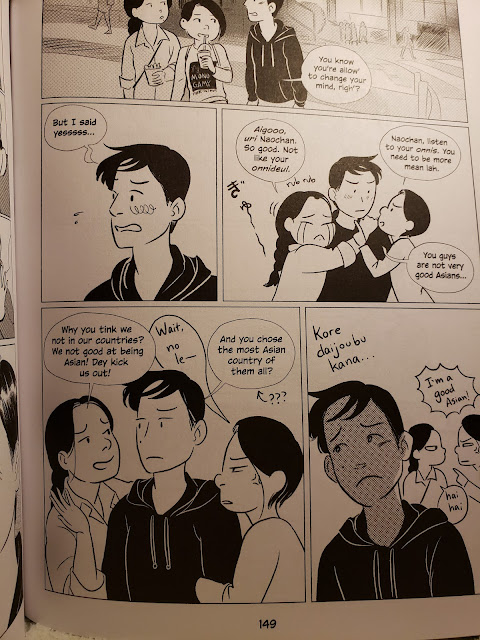
Right from the start, the book introduced a new story technique that I'd never seen before, and can only be pulled off by a true multi-lingual artist/writer. The word balloons are in 3 languages (though never all 3 in the same balloon): English, Japanese, and Korean. That's because characters in the book speak a combination of those languages. The conceit is that when a native speaker in a non-English language speaks too fast, the English translation is blurred out, struck through, or deliberately obscured, giving you the same bewildered feeling you get when someone in Japan thinks you're Japanese, and opens up her language stream at you full bore. It is an innovative technique, and it conveys exactly what the author has in mind. Since I can read a smattering of Japanese, I spot-checked many of the word balloons and to the best of my ability, all her Japanese was accurate, and so I assume that her Korean is good as well.

The book revolves around 3 women, Nao (a Japanese American) who moves to Japan for a gap year to learn Japanese better. She ends up in the shared eponymous house, and meets Hyejung (from Korea) and Tina (from Singapore), and the 3 become friends as they go to language school together and spend a year in Japan, learning about each other, and puzzling the men that they share the house with. Becker depicts Singlish accurately, including the code-switching that happens when a Singaporean speaks with someone she knows wouldn't understand the colloquialisms inherent in that dialect of English. Each chapter features a certain slice of life drama, giving you the background behind one of the characters. One of the most endearing pages of the comic has the 3 women saying to themselves that they weren't very good Asians, so they couldn't stay in their home countries, yet picked one of the most xenophobic countries in Asia to move to:

I've never lived in Japan long term, and especially not as an Asian person (many white people have lived in Japan and loved it of course), so I can't speak to the veracity of Becker's depictions, but everything in the book rings true, and none of it is cliched, and none of the events feel like invented drama.

My criticisms of the book? Well, there's a bit of the cliched Asian American "I'm neither Japanese or American" vibe. But it's not written in a "woe-is-me" self-pitying fashion. The author-stand-in character is quite privileged (all the characters are) and the drama consists entirely of first-world problems. The plot: there's no plot. It's a series of slice of life vignettes, linked together by common characters and quite touching. That's not really a criticism. Many TV sitcoms do the same. But I do like a little bit more plot in my books so this is just my personal taste.

In case you can't figure it out, I loved this book. I think you should read it. Even if you don't like the usual Asian American genre, I think you'll like this one. It's not self-centered, and it's multi-cultural in a way that's unique and truthful. It's the best comic I've read in years. Highly recommended.


Wednesday, March 06, 2019

Review: Gatchaman Complete Collection

I grew up in Singapore watching Gatchaman II (in dubbed Taiwanese translation, with the opening and closing songs stripped!), but was probably pre-TV when SBC had started broadcasting the original Gatchaman, so when I saw that BestBuy had the complete Blu Ray collection on a sale for under $40, I picked it up. I didn't expect either Bowen or Boen to be captivated by it, but Boen loved the show, so we've been watching it every so often and are now about half-way through the series.

The physical package has all sorts of details that are only impressive if you're a comic book fan. For instance, the painted box cover and the individual box disc covers (there are 3 boxes, 2 with 6 Blu Rays and 1 with 2) are done by American artist Alex Ross. Ross grew up with the American bastardized version, Battle of the Planets, and had never seen any episode in its original form prior to this set being put together, so there's an interview on the specials disc with him explaining how that art came to be and how he came to be involved, as well as a few  brief seconds of his reaction to his first exposure to the original TV show!

Let's talk about the show proper, since I've already previously reviewed the Gatchaman OAV, which was terrible. First of all, it's a Japanese show from the 1970s. Computers are huge mainframe sized creatures with tape drives, and the fashion is also fairly obvious, with bell bottoms. But more importantly, the Japanese at that time (and probably still don't) have any objections to killing and other such violence for kids TV. So the Science Ninja Team don't just karate-chop their opponents into unconsciousness, they'll run over them with cars, slash them with boomerang weapons, blow them up with explosive yoyos, and poison or kill them with feather shurikens. (Come on, they are Ninjas!) No wonder the Americans felt like they had to dial it back. (Note that despite this heavy dose of TV violence, Japan was and still is a much safer place to be a human many decades later, indicating that fantasy violence has nothing to do with real violence --- both my kids know this)

The parenting norms have also changed. One of the characters, Ken, has a father who disappeared off to do a secret mission, faking his death, leaving others to tell him that he's dead. He reappears as the mentor figure Red Impulse, but of course this isn't revealed to Ken until a critical moment whereupon his father sacrifices himself to save the planet. Bowen didn't find this believable or acceptable, but when I was a kid it seemed plausible. Absent fathers no longer seem plausible to little kids, making me wonder what current parenting behaviors will be considered unacceptable by the time Bowen's an adult.

The animation is rough at the start of the show but steadily improves all throughout the show. (The show ran for 105 episodes!) Bowen asked me, "What's different about Gatchaman?" My response was: "Stinky and Dirty is great, but you can watch the episodes out of order or even backwards and your experience wouldn't differ very much. Gatchaman is like a novel - you can't watch it backwards or it wouldn't make any sense!"  The show, like almost all Asian TV at the time, has a long story arc (the first one took about 50 episodes to cover), and is full of state: characters change, including our understanding of their relationships, and you're expected to have watched the entire series in order, with very little of each episode spent in recap (which is good - each episode is only 25 minutes long!). For  your reference, the adult TV shows my parents were watching seemed all adapted from long form narrative novels as well, for instance Louis Cha's  天龍八部 would run for 50 episodes. I believe that having early exposure to long form narrative is good for building attention span, but I have no proof to back up that assertion.

As the name implies, there is science in the series. In one of the episodes, a monster that only eats women is revealed to do so because it has an allergy to the Y-chromosome in men. Bowen asked me if chromosomes really exist after that. In another, the Van-Allen belt is the target of the villain's machinations. There's a surprising number of references to eco-friendly/sustainable building methods and lifestyles for a show that was built in the 1970s. Geothermal, nuclear, and other alternative energy sources are discussed (and of course, destroyed by mecha monsters created by the bad guys). Not every episode had a science behind it, and in fact early episodes were clumsy, with the solutions being provided by Professor Nambu who gives the team orders.

And of course, that's the weak spot of the whole series. As a kid having an International Science Organization that runs the world seemed like the way to go, but it's pretty funny to think of scientists having enough budget and power nowdaays to have all those secret bases and fancy projects at the same time while running not one, but two commando-style para-military teams with all the fancy planes, missiles and offensive weaponry.

It's also clear that the creators of the show got exposure to American superhero comics, but didn't have the language skills to comprehend the plot, so had all sorts of irrationality built into the series that are never explained or simply don't make sense. For instance, if the Science Ninja Team was employed by the ISO, why did they have secret identities and jobs? It's clear that all the trappings of a super-hero story was there, but it didn't make much sense, since the Science Ninja Team is more like a special-forces military team than a superhero team. It's just a weird carryover.

Anyway, the show's fun, draws kids attention (but beware the violence if your memories are from the sanitized American version), and has interesting attributes not available in even some of the best American kids shows today. I'm pretty sure my kids will watch it all the way to finish, as will I.

Thursday, February 21, 2019

Review: Gatchaman 1994 OVA

I realized that the 1994 Gatchaman OVA was part of the Gatchaman Complete collection. I was pretty sure that the original Gatchaman was a kids show (having grown up with Gatchaman II), but I figured I'd better curate the show before the kids asked to see it.

It turned out that I didn't have to worry. The show is boring. It's clearly aimed at the nostalgia fans, with plenty of long drawn out moments that won't mean anything if you didn't grow up with the show. (Remember the first Star Trek movie where the directors had these massive long drawn out sequences featuring the Enterprise? Those were boring to me, because I didn't care, never having seen the TV show!)

The show consists of 3 episodes, the first being drawn from the first episode of the original TV show. Well, turning a 20 minute episode into a 45 minute TV movie didn't do the plot any favors. The second features Red Impulse, and didn't feature anything worth while. The last episode finally had some action, but had none of the pathos, drama, or even sense of sacrifice the kids show had. Yes, you can allow the kids to watch it, but they wouldn't want to.

Not recommended. Watch the original instead. It's so much better.

Tuesday, October 24, 2017

Review: The Life Changing Magic of Tidying Up

Audible was giving away The Life Changing Magic of Tidying Up, so I picked it up. I had run out of things to listen to, so this became a book I listened to while driving.

The book's written in a strange, twisted fashion. In summary, the KonMari method of tidying up is fairly straightforward:

  1. Do your tidying up project all in one go. Don't try to do it incrementally.
  2. Get rid of stuff that doesn't bring you joy. (This one is bizarre, since toilet paper doesn't bring me joy but I'm not getting rid of it from my house, but I get her point --- tidying up must start with getting rid of stuff)
  3. Get rid of stuff in inverse order of difficulty (i.e., easiest stuff first). That means clothes, books/CDs first, then personal effects and momentos last. That's so you don't get distracted, and also because you'll be practiced at throwing out stuff by the time you get to the hard part.
  4. Each person in the family should have their own storage, and all their own storage should be in one place, rather than being scattered in multiple places. This ensures when you're searching for something your'e only searching for it where you are.
  5. Don't tidy for other people. If you want other people in your family to be more tidy, start by being tidy yourself.
  6. Store clothing folded, don't use hangers except for stuff that needs it. Don't rotate clothing in and out of season. Just keep it organized by weather and use case.
  7. In shelves, store things in order of height, with increasing height to the right. ("Up and to the right.")
  8. Throw out documents as soon as you're done with them. For warranties, store everything in one folder and throw out stuff that's out of date. Throw out manuals, boxes, etc. Forget about resale value and reboxing when selling.
  9. Don't worry about throwing out stuff you actually need. You can usually buy it again later if you really need it.
Yup, I just summarized everything in one check list. The rest of the book is bizarre nonsense like her strange statement that if you roll up socks, they won't be properly rested when you next put them on. (WTF!) Then she makes a big deal out of thanking your stuff. Sorry, things are things. I like my bicycles, but I didn't make a big deal out of the frame when it failed. I stripped it, sent it back to the manufacturer, and got a new one.

The book has some nice ideas, but she could have made it much shorter and easier to read and put into practice. In the last chapter she finally admits that despite her prior hyperbole about how tidying will make a massive change in your life, her experience is twisted by selection bias: the kind of people who pay her fees for her assistance in tidying up their house are the kind of people who would be predisposed to attributing all sorts of magic career changes and better health to the KonMari method.

All in all, the book has interesting ideas, but if you'd read this blog post you probably got them all! I just saved you 4 hours of reading/listening.

Wednesday, May 18, 2016

Review: eConnect Japan

I have a T-mobile Simple Choice global plan. But word from one of my friends who visits Japan frequently is that it was unreliable, and he talked me into renting a WiFi-To-Go Pocket WiFi router from eConnect Japan. I believed him because as late as in 2009, I had to rent a phone from the airline to get phone service in Japan. How quickly things change!

It turned out this was an unnecessary expense. Everywhere I had connectivity through the WiFi-To-Go router, I also had very fast internet speeds on my Moto G via T-mobile. Further more, in many cases, the Wi Fi router would go to sleep without warning, and I'd be stuck without Wi Fi, but found that my T-mobile unlimited data plan was still fast enough to make a Skype call, for instance.

On top of that, the device itself has a natively small battery, so eConnect supplies you with a battery extender that you then plug into it. That battery would last all day, but now you have 2 more things to charge at night instead of one. Given that we were traveling light, I only brought a 2-way charger, so it was a bit of a chore getting all the devices charged.

I supposed if we made use of the tablet more, the WiFi router might have come in useful. Even then, the package we received had all sorts of warnings against download video, large files, or doing anything interesting with the WiFi router.

In any case, I found myself regretting that I paid eConnect any money at all, and by contrast, was very happy with my Moto G running on T-mobile. Next time, I will not bother with eConnect, and I suggest you don't, either.

Friday, May 13, 2016

Review: Deuter Kid Comfort III Baby Carrier

In 2013, I killed the Kelty FC 3.0 Child Carrier. My rule with equipment is that if I kill it once, I'll exchange it at REI. If I kill it twice, I'll shop for something better. In this case, I got a coupon which got me the Deuter Kid Comfort III for under $230, as opposed to the regular $300 price.

I just came back from a 2 week trip in Japan where I didn't bother bringing a stroller and just carried Boen around in the backpack whenever we needed to transport him. The backpack is rated for about 40 pounds of kid and 9 pounds of gear. It has a built in sun shield/rain shield, but is an open configured backpack, so don't expect it to keep your kid dry in rain without him wearing waterproof clothing. In practice, mommy will probably scream at you long before kiddie gets wet and cold.

The major problem with this pack is that it's not really made for skinny men with no hips. As you can guess, I fall into that category, so I cinch up the waist belt all the way to minimum, clip it on, and luckily that's enough that it doesn't slip. Once you do that, all the weight is on your hip and you can definitely move around with the kid all day.
As you can see, I could bend down and shoot one kid and still have the other one in the backpack. I wouldn't call it the most comfortable position in the world, but it's doable, and I was doing this multiple days during the trip. At various points during the trip, I'd have Boen in the backpack, be towing a rolling luggage, have my CPAP sling bag around my neck, and the EOS M3 kit in a bag around my neck as well, and then walk to the hotel from the train station. That I could manage it all was a testament to how comfortable this pack was.

Boen seemed very comfortable as well, falling asleep in the backpack more than once. When Boen wasn't using the bag, Bowen would try to get into the bag and sit in it. I've carried Bowen in it a couple of times (he weighs about 10 pounds more than Boen). It's OK, but it's not more comfortable than just carrying him directly on my shoulders, though it probably is more comfortable for him. Since the pack itself weighs almost 10 pounds, whenever I can carry Bowen on my shoulders I do so rather than using the pack.

The one bug is in the kick-stand. It is possible for the kick-stand to fold in under the lowest metal bar at the bottom of the pack. Then when you reach back to unfold it you'll have to yank and yank to get it to unfold so you can put the pack down. If there's any improvement feasible, I'd say that limiting the motion of the folding kick-stand to eliminate this possibility would be high on my list of priorities.

I consider baby backpacks much better than any of the alternative carrier systems. They scale up better than any front carriers, and this one provides nice features like a built in hydration setup. It's expensive, but I guess having kids is just plain expensive and there's no way around it. Recommended.

Wednesday, May 11, 2016

Japan 2016: Thoughts and Conclusions

Japan is very kid friendly. Before we left Xiaoqin was told by people that strollers, etc. were a handful to manage in Japanese cities. We left the stroller behind, and that was a good choice, since it made buses, subways, etc. easy. What I noticed, however, was that every urinal we found in Japan was usable by Bowen. Everywhere we went, people loved both Boen and Bowen. Hotels and restaurants were happy to make accommodations, up to and including putting us in a room with a play pen, or having a nap area right next to the dining table. Our only problem was finding western style baby food (not because Boen couldn't handle Japanese-style baby food, but because the packaging was more convenient for travelers) and diapers, both of which were solved by having very helpful Japanese strangers put in extraordinary efforts on our behalf. So I'd happily travel in Japan with kids.

Bicycle travel really is a gift. I say that after this year's trip, because the contrasts between this year's trip and the 2009 Tour of Hokkaido couldn't be starker. Thinking back upon it, you might even have a hard time believing that it's the same country. My memories of the 2009 tour was gobs of hot springs, including isolated open air public springs where no one else was nearby. My memories from this year's trip is throngs of crowds at temples, except for those few days in Matsumoto. Country hostels, night markets that we happened to ride into, and wild isolated but pretty spots in Hokkaido were certainly missed.

All throughout our Hokkaido trip, I was continually told that "you're seeing the real Japan." At that time, I dismissed it to the similar (false) American creed that people in cities are not real, just the country side is real. What I now realize is that it's not just the country-side: it's that we were venturing out into a Japan that didn't speak English, where we interacted deeply with local people (despite my limited Japanese), and the terrain in a way that's denied to you when you're not traveling by bicycle or on foot.

In both cases, the Japanese are the most polite, ultra-helpful people you'll ever encounter in the world. I'll never forget the woman who took a half hour out of her day to try to help us find baby food in Shinjuku, the busiest train station in the world. She even apologized for it taking a long time! And of course, the brothers who ran Drum Kan who not only drove us to the hot spring and went in with us, but also cooked dinner and then played a Rock concert for us that evening! But as a cyclist you really do get treated differently than other tourists, and you have to interact with locals deeply in a way I never had to on this year's trip.

One of the subtlest thing in the 2009 tour was how we got cleaner and cleaner as the trip progressed. As cyclists we frequently used public baths, and were constantly exposed to how Japanese scrub and clean themselves. And when I say scrub I mean it: I swear by the time a Japanese person is done with their scrub, the entire upper layer of epidermis must have been gone! Over the 2 weeks of our bike tour, we got so inculcated with this that by the time we got home we were scrubbing like the locals. This time, because we mostly stayed at private hotels and AirBnB homes, that effect never happened. I never felt anything other than being a visitor, whereas in 2009, I truly felt like I'd traveled!

I've often said that I don't think I'll ever go back to Japan on a bike tour. The cycling is horrible compared to my beloved Bay Area: the mountain roads have too many tunnels, and views are few and far between: even on this trip, our short stint on the freeway brought better views than our travels in the mountains. The trains aren't bike friendly. Perhaps as my boys get older we'll contemplate some onsen-to-onsen hiking in some of the Japanese national parks, and that might expose them to the more cultural aspects of travel, but if that fails I might reconsider my prohibition against further cycling trips in Japan.

But of course, this time we got to experience a real Japanese Ryokan, and that's really something that's tough to arrange on a bike tour. You can't beat the service. A $800/night Ryokan in Japan provides far better service, food, and ambiance than a $2,000/night Four Seasons in Hawaii. It's expensive, but it's far better value for money, and I'm a cheap-skate of the highest order and would never consider the latter but the consider the former a nice occasional treat.

All in all, if I had the trip to do all over again, I'd spend more time in Kyoto, skip one night in Nara, and spend a day less in Tokyo. But that's all relatively minor. I'd highly recommend Sugimoto and Matsumoto castle, and spend more time on the Philosopher's Path in Kyoto.

Tuesday, May 10, 2016

Japan 2016: Mitaka

We got up at 6:15am, got everything packed and left the hotel, making the 7:04 Kintetsu Express to Kyoto. At Kyoto station, we bought brunch and boarded the 8:24 Tokyo bound Shinkansen. Then we got into Tokyo station and boarded the local express to Mitaka, where we got off at the wrong station exit so we could use the rest room, and then went back to find the Studio Ghibli museum bus.
Ever since he saw My Neighbor Totoro and accumulated a posse of stuffed Totoros, Bowen's been a big fan of Totoro. The museum, unfortunately, did not let you take pictures inside!
From Japan 2016
From Japan 2016
From Japan 2016
From Japan 2016
Though small, the museum was very well done, including a cat bus play area (which you needed to line up for), a maze, a movie theater (which your entrance ticket doubled as an entry stub), displays and examples of animation, including a stroboscope display that was just amazing. It's well worth the visit, though you probably should have planned better than I did and not pay scalper prices for tickets.
After that, we visited Ryu's AirBnB which were an hour away. Ryu had his house keeper waiting for us so we moved in. Xiaoqin was tasked with buying some items for her friend, so we went to the closest tax-free department store. Wow, women's cosmetics, it turns out are just like cars and houses --- the profit margins are so high that it's worth while for companies to pay commissioned sales people to sell them to you. I did have one last item to get from Japan, which was 64GB Vita memory cards. Those cost $100 in the US, but $75 tax free in Japan, but you have to buy 2 to get the tax deduction, so I bought 2 knowing that I could flip one if necessary.

On our last day, Ryu picked us up from our AirBnB and drove us to the train station where he showed us how to take the SkyTrain to Narita airport. It's a fast 45 minute trip via express train and got us well-rested for the hyper-stressful 9 hour trip back to the USA.

Monday, May 09, 2016

Japan 2016: Nara

We grabbed a bus to Kyoto Station and then went in to buy tickets for the express train. To my dismay, the primary ticket machines were incomprehensible, so we went into the service counter to line up. At the last minute, I saw that there was a JR Rail machine, and tried to use my American credit card to buy a ticket to Nara. That worked great, and we were soon on the express train to Nara. Once there, Google projected an 8 minute walk to the hotel, but biff'd on finding the entrance. Luckily, the entrance wasn't that far. It was too early to checkin but we could leave our luggage at the hotel.
From Japan 2016
Xiaoqin wanted to come to Nara to see Daibutsu, so we walked through the city's parks to the information center, and were then directed along a route that took in more temples, and some reindeer!
From Japan 2016
From Japan 2016
The temple was very crowded, with hordes of school children, bus loads full of tourists, and tour guides armed with megaphones for both crowds. We walked in slowly and gaped at the huge Buddha statue and various accompaniments before leaving to get ice cream in the heat.
From Japan 2016
After that, everyone else was too exhausted to do more walking, so I set off by myself to explore Nara. My first stop was the Kintetsu station, which was not the same as the JR Nara station. It turned out that in this part of Japan there were two major rail networks with their own stations! I wanted the bullet train from Kyoto, but the Kintetsu station was closer to our hotel, so I had to confirm that (1) yes, I had to buy my tickets from two different companies, and that (2) the 14 minute connection was realistic at Kyoto, because the Kintetsu and JR Shinkansen lines shared a common terminal separated only by a 3 minute walk. Since the Shinkansen ticket was by far the most expensive one, I then walked over to the JR Rail HQ and stood inline for multiple minutes so I could buy reserved seats that would take us to the Studio Ghibli museum on Friday. Along the way, I found a mechanical toy museum, but it was closed on Wednesday.

It rained the next day, but first we had to find more diapers for Boen. This proved to be a surprisingly difficult task, and I eventually enlisted the help of the tourist information counter at the Kintetsu train station. She walked us through 2 more drug stores before finding one! If we'd been searching for adult diapers, it would have been no problem: those were on sale everywhere! I then bought tickets for the Kintetsu rail portion of the next day's trip, and took Bowen to the mechanical toy museum in Nara.
What a great museum that was. It was fully curated, but you were allowed to play with the toys as much as you like. The tops were a lot of fun, and there was even a mini kabuki show/demonstration. Highly recommended even if you don't have kids --- in fact, I was the only person there with a child accomplice!

The day turned out to be a nice quiet day for us because of the rain. We didn't see any sights, but got to live like a local, exploring the local shopping streets, buying take out food, and in general chilling out. This was great, since the next day was an early start, as we had Studio Ghibli tickets for a 12:00pm entry in Tokyo.