Compared to the General Fund Deficit, Social Security's impending deficit in 2040 is not a problem. [source] Medicare is in significant trouble, but before things get too bad, we'll simply be forced to have a rational, national healthcare system like all the other industrialized countries (and have better health outcomes to boot, what a tragedy), so that problem is a matter of political will, not an inevitable disaster.
The General Fund deficit, however, will persist as long as Republicans stay evil and as long as they keep winning the three branches of government. The fact that they're not currently popular doesn't mean that they won't resort to other methods of stealing the election.
Sunday, May 14, 2006


Black Mountain Today
It was hot, about 83 degrees. About a mile from the top, I ran into a guy wearing a Coast-To-Coast T-shirt. I mentioned to him and his wife that Lisa & I were going to do the walk in a couple of weeks. They told me they did the trip 7 years ago, and that they were so lucky that they had only one day of rain out of about 16. That's pretty darn good, considering my own Scotland trip about 11 years ago had much more rain than that.
They did mention that the first few days was quite hilly. I asked how bad it was, and they said about 2500'. Why, I said, that's about the same height as Black Mountain! They agreed, and said that if you'd been climbing it all year, it was probably nothing scary.
This is one of the things I love about the Bay Area. No matter where else in the world you go, if someone else tells you how steep or high the mountains are, after you've asked a bit, you'll realize that it's nowhere as steep or as tough as they think it is, since the Bay Area has plenty of steep, tough hills.
They did mention that the first few days was quite hilly. I asked how bad it was, and they said about 2500'. Why, I said, that's about the same height as Black Mountain! They agreed, and said that if you'd been climbing it all year, it was probably nothing scary.
This is one of the things I love about the Bay Area. No matter where else in the world you go, if someone else tells you how steep or high the mountains are, after you've asked a bit, you'll realize that it's nowhere as steep or as tough as they think it is, since the Bay Area has plenty of steep, tough hills.
Saturday, May 13, 2006
The Paradox of Choice
This is a great video, especially since the material is fascinating (unfortunately, the cartoons he shows are copyrighted, so the video omits them, which makes it very annoying when the audience is laughing at a cartoon and you don't get to see it!). Basically, humans have several reactions when confronted with too many choices. One possible reaction is paralysis, which explains why many people don't sign up for 401(k) plans --- they don't know which fund to choose so they end up doing nothing. Another possible reaction is to spend a lot of time going through the choices in an attempt to maxmize satisfaction but in the end being disappointed, since if there are 200 choices and you're less than perfectly happy with your choice then it must be your fault. Finally, the fact that you have so many choices can make you devalue all of them.
This does seem ironic, since choice is an incredibly positive thing. My personal solution is to make a decision appropriately, and then not spend any time reflecting on its goodness or badness other than to learn what I can from it. You can't live life as one regret after another, or you'll have a very sad life. If you question all your past decisions all the time, you're not going to be very productive, either.
Finally, this video also explains why people hire agents: even though many agents are corrupt, have other conflicts of interests, or simply incompetent, for a lot of people, having an agent make the agonizing decision for you eliminates the unhappy feelings they have about making the decision themselves.
This does seem ironic, since choice is an incredibly positive thing. My personal solution is to make a decision appropriately, and then not spend any time reflecting on its goodness or badness other than to learn what I can from it. You can't live life as one regret after another, or you'll have a very sad life. If you question all your past decisions all the time, you're not going to be very productive, either.
Finally, this video also explains why people hire agents: even though many agents are corrupt, have other conflicts of interests, or simply incompetent, for a lot of people, having an agent make the agonizing decision for you eliminates the unhappy feelings they have about making the decision themselves.
An interesting financial question
Someone approached me the other day with an interesting financial quandry. I think I've analyzed it correctly, but it's worth writing down the question and the answer in case one of my readers points out an obvious flaw in my answer.
Q: I have a large amount of U.S. dollars to invest. I currently live and work in the U.S., but as I do not have a green card I do not know how long I would stay in this country or even want to be here. However, there is a significant chance that I might settle here in the long term. What should I do with my investments?
A: If this answer was something that would be resolvable in a year or so I'd just tell you to wait and see. But seeing that you're sitting on a pile of cash that you definitely will want to invest for retirement, I suggest that you build two portfolios: one in your home country and one here in the U.S. Within each portfolio you would perform your asset allocation essentially, each porfolio mirrors the other: the only difference is that one is denominated in U.S. dollars, and the other denominated in Euros.
The reason for the mirror'd accounts is that of paying round-trip costs. Let say you bought European investments in a Vanguard European Index Fund. The problem is that when you need to withdraw, you'll be paying two round-trip conversions, from Euros to U.S. dollars and back again. That's inefficient when you already have a European account and can directly trade a European index. You could also perform balancing between accounts. For instance, hold all US Equity in the American fund, and all European equity in the European account. Hold US Bonds in the American fund, and European bonds in the European account. Split your Asia-Pacific and Emerging market funds between both accounts. This ensures that you never pay round-trip conversions whenever you can help it.
You face some obvious problems: we know that there are low cost, efficient instruments in the U.S. for long term investments, such as the Vanguard Index Funds. I don't know if such instruments exist in Europe. You'll have to do your research and study the funds carefully. For instance, if an efficient International Fund is not available in Europe, you might be better off paying the round trip cost and holding everything in the U.S.
Q: I have a large amount of U.S. dollars to invest. I currently live and work in the U.S., but as I do not have a green card I do not know how long I would stay in this country or even want to be here. However, there is a significant chance that I might settle here in the long term. What should I do with my investments?
A: If this answer was something that would be resolvable in a year or so I'd just tell you to wait and see. But seeing that you're sitting on a pile of cash that you definitely will want to invest for retirement, I suggest that you build two portfolios: one in your home country and one here in the U.S. Within each portfolio you would perform your asset allocation essentially, each porfolio mirrors the other: the only difference is that one is denominated in U.S. dollars, and the other denominated in Euros.
The reason for the mirror'd accounts is that of paying round-trip costs. Let say you bought European investments in a Vanguard European Index Fund. The problem is that when you need to withdraw, you'll be paying two round-trip conversions, from Euros to U.S. dollars and back again. That's inefficient when you already have a European account and can directly trade a European index. You could also perform balancing between accounts. For instance, hold all US Equity in the American fund, and all European equity in the European account. Hold US Bonds in the American fund, and European bonds in the European account. Split your Asia-Pacific and Emerging market funds between both accounts. This ensures that you never pay round-trip conversions whenever you can help it.
You face some obvious problems: we know that there are low cost, efficient instruments in the U.S. for long term investments, such as the Vanguard Index Funds. I don't know if such instruments exist in Europe. You'll have to do your research and study the funds carefully. For instance, if an efficient International Fund is not available in Europe, you might be better off paying the round trip cost and holding everything in the U.S.
Another AppleCare Success Story. NOT!
Despite Apple receiving the dead machine on the 11th, they've told me they will only ship my replacement on the 18th! Is this a company that wants my future custom? Doesn't seem like it to me right now. They're using up half my 30 day free AppleCare support with one DOA.
Book Review: The Four Pillars of Investing
Wlliam Bernstein is the author behind The Efficient Frontier, the website discussing asset allocation and the theory and tools behind it. Bernstein wrote two books on investing, his first being The Intelligent Asset Allocator, a technical discussion of Asset allocation. This is the book, he says, for liberal arts major. (I did get a Bachelor of Arts in Computer Science, so this book is for me!)
Being a big fan of asset allocation, Bernstein writes:
since you cannot successfully time the market or select individaul stocks, asset allocation should be the major focus of your investment strategy, because it is the only factor affecting your investment risk and return that you can control
This is generally good advice, and his chapters on indexing, market timing, bubbles, and history are really good, and very much worth reading. His actual sample portfolios, however, are excessively complicated. For instance, for a taxable account, he suggests a bond portfolio that looks like this:
For his tax-sheltered example, he goes for something even more complex for the equity portion:
Ultimately, there's a lot of value in keeping your portfolio simple and easy to follow. When you see something that seems really complicated and hard to manage, run away and go for something simpler. I doubt if Bernstein's hypothetical tax-sheltered account would do much worse with:
[Addendum: The reason Bernstein recommends holding the components of the Total International Index is that you get the foreign dividend tax credit, which reduces your overall costs. This is a big enough deal that it's worth considering. I still think there's value in simplicity, however.]
Being a big fan of asset allocation, Bernstein writes:
since you cannot successfully time the market or select individaul stocks, asset allocation should be the major focus of your investment strategy, because it is the only factor affecting your investment risk and return that you can control
This is generally good advice, and his chapters on indexing, market timing, bubbles, and history are really good, and very much worth reading. His actual sample portfolios, however, are excessively complicated. For instance, for a taxable account, he suggests a bond portfolio that looks like this:
- 25% Treasury Ladder
- 25% Vanguard Short-Team Corporate Bond
- 25% Vanguard Limited Term Tax-Exempt
- 25% Vanguard California Intermediate-Term Tax-Exempt
For his tax-sheltered example, he goes for something even more complex for the equity portion:
- 20% Vanguard 500 Index
- 25% Vanguard Value Index
- 5% Vanguard Small Cap Index
- 15% Vanguard Small Cap Value Index
- 10% Vanguard REIT Index
- 3% Vanguard Precious Metals
- 5% Vanguard European Stock Index
- 5% Vanguard Pacific Stock Index
- 5% Vanguard Emerging Stock Markets Index
- 7% Vanguard International Value
- Rebalancing between all these portfolio is a chore, and I doubt if most individual investors would enjoy having this many options
- Meeting the minimums alone would require a fairly substantial tax-sheltered portfolio
- Most 401(k) plans won't give you a good enough selection of Vanguard funds to enable you to cover such diversification.
- By having so many small accounts, you ignore the benefit of being able to qualify for Vanguard's Admiral shares, which have a significant reduction in expenses. Such reduction in expenses might cause your ultimate return to be higher than a complex portfolio, also partly because you are more likely to be able to rebalance such a portfolio on a regular basis.
Ultimately, there's a lot of value in keeping your portfolio simple and easy to follow. When you see something that seems really complicated and hard to manage, run away and go for something simpler. I doubt if Bernstein's hypothetical tax-sheltered account would do much worse with:
- 65% Vanguard Total Stock Market Index
- 10% Vanguard REIT Index
- 3% Vanguard Precious Metals
- 22% Vanguard Total International Index
[Addendum: The reason Bernstein recommends holding the components of the Total International Index is that you get the foreign dividend tax credit, which reduces your overall costs. This is a big enough deal that it's worth considering. I still think there's value in simplicity, however.]
Friday, May 12, 2006
Brad DeLong: Immigration is a good thing
Ok, I'm not trying to reopen a debate I had with BuddhaMouse about immigration, but I came across Brad's Morning Coffee series on Google Video, and can't help pointing it out.
The entire series is very much worth watching (each video is only about 5 minutes long, so it's not a big time sink) by the way, and I didn't really become a Google Video fan until this series of videos, along with the Google EngEDU series were posted.
The entire series is very much worth watching (each video is only about 5 minutes long, so it's not a big time sink) by the way, and I didn't really become a Google Video fan until this series of videos, along with the Google EngEDU series were posted.
Thursday, May 11, 2006
Lisa's Laptop
We considered Dell, where we had coupons and an employee purchase plan discount. But Dell's site is annoying and irritating, and you can't easily compare prices because they sell different models to different customers, all ending up with the equivalent price. That alone was enough to annoy me into trying different venues.
Fortunately, Buy.com had pretty good deals on the Acer Aspire 5670 series of laptops. After digging around and finding a coupon in my mailbox, we ended up with an after-tax-and-shipping price of $980 for a 1GB machine with a dual-core CPU, a DVD burner, a built-in camera, 100GB of disk space, and a very nice remote (much nicer than the one that comes with the Mac Mini). Sure, it's not as cute as the Mac Mini, but it comes with a very nice screen, an excellent graphics card, and all the same extras for about $100 less than what Apple sells its entry-model machine for. The only advantage the Mac has over the Acer is that the Mac will have 2GB of memory (which is admittedly very expensive right now).
MacOS X is a nice operating system, but I'm pretty sure if I tried really hard I could probably boot Linux on the Acer. I guess we'll see what the reliability is like, but my guess is that the Mac and the Acer will be comparable.
Fortunately, Buy.com had pretty good deals on the Acer Aspire 5670 series of laptops. After digging around and finding a coupon in my mailbox, we ended up with an after-tax-and-shipping price of $980 for a 1GB machine with a dual-core CPU, a DVD burner, a built-in camera, 100GB of disk space, and a very nice remote (much nicer than the one that comes with the Mac Mini). Sure, it's not as cute as the Mac Mini, but it comes with a very nice screen, an excellent graphics card, and all the same extras for about $100 less than what Apple sells its entry-model machine for. The only advantage the Mac has over the Acer is that the Mac will have 2GB of memory (which is admittedly very expensive right now).
MacOS X is a nice operating system, but I'm pretty sure if I tried really hard I could probably boot Linux on the Acer. I guess we'll see what the reliability is like, but my guess is that the Mac and the Acer will be comparable.
Tuesday, May 09, 2006
A dead Mac
After speculating about the Macintosh's reliability, my fears are confirmed. My Mac Mini CDROM drive, after a mere week of service, has given up the ghost. To add insult to injury, it took a physical visit to an Apple store and a verification by an Apple Genius before Apple would agree to RMA the product. Even then, they want me to drop off the machine to Fedex before they'll ship me a new one.
By contrast, my brother tells me that Dell would ship me a new machine as soon as they agree to RMA an old machine, so that I'd never be without a computer.
Lisa's 5 year old Dell laptop just recently gave up the ghost (yes, I've been suffering a rash of hardware failures), and after seeing the reliability problems with the Intel Mac Mini, she's decided that her next laptop will also be a Dell.
By contrast, my brother tells me that Dell would ship me a new machine as soon as they agree to RMA an old machine, so that I'd never be without a computer.
Lisa's 5 year old Dell laptop just recently gave up the ghost (yes, I've been suffering a rash of hardware failures), and after seeing the reliability problems with the Intel Mac Mini, she's decided that her next laptop will also be a Dell.
Sunday, May 07, 2006
This new issue of I-bonds might be a good buy
The financial press that mentions I bonds at all (a scant few, admittedly) is complaining that the rates that got reset this month were low at a 2.41% are really low compared with prevailing interest rates of 4.5% or more. What they are ignoring is that the real rate went up from 1% to 1.4%. In the long run, the real rate is what you care about, since the inflation adjusted rate will fluctuated with CPI. This series of I bonds are a really good buy if you believe that inflation is going up in the long run (which I think is a good bet). If I hadn't already loaded up on them this year, I'd be buying more. In fact, this might indeed be motivation for me to go down to the local bank and buy paper I bonds. The rate resets again in October.
There is no such thing as talent
This New York Times article (registration required) says that people who are good at something spend a lot of time practicing and becoming good at it. The conclusion being that when it comes to choosing a life path, you should do what you love — because if you don't love it, you are unlikely to work hard enough to get very good. There are many interpretations of this, of course, but it accounts for a lot of the difference in performance in Math between Asians and Americans (as seen in how badly American kids do badly when on average). When an Asian kid complains about how hard Math is and how she doesn't like it, her parents are very likely to push her, find a different tutor, anything to make her better. It's not unusual to hear Americans saying "I have no talent for it" instead.
The same thing was described in unlocking the clubhouse, a description of CMU's effort to increase its proportion of female students in Computer Science. In it, there was a section describing how women students from Asia tended to stay in Computer Science rather than the non-Asians. The reason wasn't because the women were mysteriously more talented, it was that they didn't feel that they had a choice --- dropping out would have meant a loss in face or a return to a society they had worked so hard to leave.
So while the general conclusion the New York Times might draw is that you should choose to do what you love, because that way you'll be willing and happy to work hard at it, an Asian parent might, upon seeing these results, conclude that there isn't an excuse for poor results at school --- that simply means you aren't working hard enough. While the former approach might result in happier lives (though I do recall Malcolm Gladwell talking at Google about stellar performers not necessarily leading very happy lives because they're so driven), the latter is what causes Americans to lag behind in Math and Science education. The rest of the world sees in Math and Science an opportunity to lift themselves out of poverty, what I'm seeing is that more and more Americans seem to deem Math and Science as a necessary evil, not very highly prized and easily jettisoned whenever it conflicts with religion.
[Thanks to Greg Mankiw for the pointer.]
The same thing was described in unlocking the clubhouse, a description of CMU's effort to increase its proportion of female students in Computer Science. In it, there was a section describing how women students from Asia tended to stay in Computer Science rather than the non-Asians. The reason wasn't because the women were mysteriously more talented, it was that they didn't feel that they had a choice --- dropping out would have meant a loss in face or a return to a society they had worked so hard to leave.
So while the general conclusion the New York Times might draw is that you should choose to do what you love, because that way you'll be willing and happy to work hard at it, an Asian parent might, upon seeing these results, conclude that there isn't an excuse for poor results at school --- that simply means you aren't working hard enough. While the former approach might result in happier lives (though I do recall Malcolm Gladwell talking at Google about stellar performers not necessarily leading very happy lives because they're so driven), the latter is what causes Americans to lag behind in Math and Science education. The rest of the world sees in Math and Science an opportunity to lift themselves out of poverty, what I'm seeing is that more and more Americans seem to deem Math and Science as a necessary evil, not very highly prized and easily jettisoned whenever it conflicts with religion.
[Thanks to Greg Mankiw for the pointer.]
Saturday, May 06, 2006
Review: Everything Bad is Good For You
This is a quick read, mostly because the content can really be summarized really quickly: current and new TV shows and video games are becoming more and more complex, with the result that they provide a cognitive load that's surprisingly large and capable of providing intellectual stimulation and teaching problem solving skills that are useful in many other aspects of life.
The possible expense, Johnson points out, is that we've become a frentic, soundbite society that's incapable of pondering long range problems and goals. But that's always been true throughout human history (a read of Collapse will provide sufficient proof of that), so common lamentations about how kids are wasting their time playing video games are largely irrelevant.
One study at the University of Rochester asked subjects to perform a series of quick visual recogniation tests... Regular gamers consistently outperformed non-gamers on all the skills measured by the study... Games were literaly making them perceive the world more clearly... the gaming population turned out to be consistently more social, more confident, and more comfortable solving problems creatively. They also showed no evidence of reduced attention spans compared with non-gamers.
The possible expense, Johnson points out, is that we've become a frentic, soundbite society that's incapable of pondering long range problems and goals. But that's always been true throughout human history (a read of Collapse will provide sufficient proof of that), so common lamentations about how kids are wasting their time playing video games are largely irrelevant.
One study at the University of Rochester asked subjects to perform a series of quick visual recogniation tests... Regular gamers consistently outperformed non-gamers on all the skills measured by the study... Games were literaly making them perceive the world more clearly... the gaming population turned out to be consistently more social, more confident, and more comfortable solving problems creatively. They also showed no evidence of reduced attention spans compared with non-gamers.
Is Mandantory Financial Education A Solution?
Earlier in our conversation, Buddha Mouse suggested that a mandantory program of financial lessons might be implemented in school for most folks.
While I won't oppose such an idea, I think that this will not have as great an effect on poverty as she might hope becaues:
This idea was proposed in Gene Sperling's book , and I think it has a lot of merit. The chances of it happening in our pro-wealthy Republican Congress, Senate, and White House are effectively nil. But the reason I'm pissed at Democrats as well is that not one of the forty-something senators in the Senate have had the guts to even propose something like this. If the Democrats continue not proposing and trying to get through such good ideas, they're going to keep losing elections.
While I won't oppose such an idea, I think that this will not have as great an effect on poverty as she might hope becaues:
- To be able to save, you must have enough money to eat, pay rent, and pay for clothing. If you're making below the national poverty level, it's quite likely that you'll have trouble saving.
- Most people are surprisingly bad investors. Many folks I know either aren't interested in the subject of financial planning (in which case, they'll get Cs or Ds) in the class, or even when they know what the right thing to do is, they're not emotionally capable of doing it. I have a very smart and intelligent friend who can't bring himself to buy I-bonds, because the electronic product is too intangible.
- Financial planning is suprisingly hard! Even people like me take more than an hour to rebalance a relatively simple portfolio. If you're short on time, or don't enjoy it, you're simply not likely to do it.
This idea was proposed in Gene Sperling's book , and I think it has a lot of merit. The chances of it happening in our pro-wealthy Republican Congress, Senate, and White House are effectively nil. But the reason I'm pissed at Democrats as well is that not one of the forty-something senators in the Senate have had the guts to even propose something like this. If the Democrats continue not proposing and trying to get through such good ideas, they're going to keep losing elections.
New Computer
After my last computer died, I bought a Mac Mini. The computer took about a week to get to me: 2 days for the customization (I ordered 2GB of RAM), and another 3 days in shipping, and then 1 day while it got misdirected.
After having it for a few days, here are my first impressions:
1. I thought that 2GB might be overkill. Turns out that this is not true. My typical working set under Mac OS X appears to be about 1.2GB, just enough to cause my machine to swap if I had bought a 1GB machine.
2. A few things aren't as intuitive as you might imagine. For instance, I had to edit a Samba mount to share an external (USB) drive.
3. Mac OS X is a bit of a disk hog. The 80GB that came with the machine are going to go really fast, especially if you intend to dual boot the machine into Windows.
4. If your favorite environment is Emacs, you're going to have to use special instructions for building GNU Emacs v22 for Mac.
5. A few things still feel a bit sluggish. I think the extra special effects contribute to the feel. Things fade in and out instead of just snapping in and out like I'm used to.
6. Having UNIX interface underneath is really really nice.
7. The text edit fields in the web browsers seem really slow. I'm running the Universal Binary version of firefox, so it's got nothing to do with the binary.
8. The machine is much louder than expected. When it's in sleep mode or when not much is happening, it's dead silent. But rip a CD or two, compile Emacs, and the fan kicks up and you can hear it from across the room. Fortunately, like most engineers, I spend most of my time editing text and reading.
9. Despite the much vaunted UI that's not supposed to go wrong, I already managed to screw up the registry equivalent once by installing two versions of Microsoft Office.
10. 2 CPU cores are really nice too. Even when compiling, using web browsers or other apps don't bog down at all.
11. Now I have a more powerful machine at home than I have at work (my work machine is about 3 years old).
I'm still slowly warming up to the UI, so we'll see how I feel a bit later. In particular, I'm going to start running Windows XP (both as a bootcamp'd partition for games, and as a virtualized machine for quicken and possibly photoshop, which isn't going to have a universal binary version for awhile).
After having it for a few days, here are my first impressions:
1. I thought that 2GB might be overkill. Turns out that this is not true. My typical working set under Mac OS X appears to be about 1.2GB, just enough to cause my machine to swap if I had bought a 1GB machine.
2. A few things aren't as intuitive as you might imagine. For instance, I had to edit a Samba mount to share an external (USB) drive.
3. Mac OS X is a bit of a disk hog. The 80GB that came with the machine are going to go really fast, especially if you intend to dual boot the machine into Windows.
4. If your favorite environment is Emacs, you're going to have to use special instructions for building GNU Emacs v22 for Mac.
5. A few things still feel a bit sluggish. I think the extra special effects contribute to the feel. Things fade in and out instead of just snapping in and out like I'm used to.
6. Having UNIX interface underneath is really really nice.
7. The text edit fields in the web browsers seem really slow. I'm running the Universal Binary version of firefox, so it's got nothing to do with the binary.
8. The machine is much louder than expected. When it's in sleep mode or when not much is happening, it's dead silent. But rip a CD or two, compile Emacs, and the fan kicks up and you can hear it from across the room. Fortunately, like most engineers, I spend most of my time editing text and reading.
9. Despite the much vaunted UI that's not supposed to go wrong, I already managed to screw up the registry equivalent once by installing two versions of Microsoft Office.
10. 2 CPU cores are really nice too. Even when compiling, using web browsers or other apps don't bog down at all.
11. Now I have a more powerful machine at home than I have at work (my work machine is about 3 years old).
I'm still slowly warming up to the UI, so we'll see how I feel a bit later. In particular, I'm going to start running Windows XP (both as a bootcamp'd partition for games, and as a virtualized machine for quicken and possibly photoshop, which isn't going to have a universal binary version for awhile).
Thursday, May 04, 2006
It's easier to rig an election than to fool a slot machine
Is it likely that the Republicans rigged the 2004 elections? Probably not. Is it likely that the companies which produced the voting machines (most of which were owned by Republicans) rigged the machines? That's not out of the question. What surprises me is that the press hasn't covered this story at all. But then again, a glance at Delong's blog will convince you that our press corps are know-nothings. English and Journalism majors are simply too incompetent at complex issues to do a proper job of covering our world today.
Sunday, April 30, 2006

Saturday, April 29, 2006
My next desktop....
Yes, I've picked the Intel Mac Mini. The runner up was the Lenovo Thinkpad X60s, which is two generations later than my work laptop, which is an X31. The Thinkpad X series have absolutely amazing battery life, fantastic keyboards (much better than the Mac laptop keyboards, which I find detestable),and very good performance and has proven very reliable.
The Mac Mini with 2GB of RAM, however, with a suitable discount (thanks to a good friend who works at Apple), was a good $1000 cheaper than an equivalently tricked out X60s, which only has 1GB of RAM, but a much faster processor, and of course, comes with its own screen. A surprisingly big contributor to the cost is the cost of the MiniDock, since the laptop does not come with a DVI connector, and obviously doesn't have slots so I could install one.
Of course, I've heard horror stories about the Mac's reliability (one of my office mates had a broken Powerbook screen, and another colleague had a bad hard drive soon after he bought a new Powerbook as well), and lack of Intel-native software is a liability (especially stuff like Photoshop, which is the only reason you'd want to trick out a Mac Mini with 2GB of RAM). Fortunately, with Boot Camp, I can turn it into a Windows XP box and run my 5 year old copy of Photoshop 6 (and it'll still run circles around MacBooks or Intel iMacs running MacOS photoshops), as well as any of my old software.
A suitably tricked out Dell, by the way, cost about the same as the Intel Mac Mini, but came with a much larger form factor (and admittedly, more expandability). I've avoided Apple products in the past mostly because of their insanely high cost, but with the iPod and the Mac Mini, they've proven themselves capable of competing with commodity products.
The Mac Mini with 2GB of RAM, however, with a suitable discount (thanks to a good friend who works at Apple), was a good $1000 cheaper than an equivalently tricked out X60s, which only has 1GB of RAM, but a much faster processor, and of course, comes with its own screen. A surprisingly big contributor to the cost is the cost of the MiniDock, since the laptop does not come with a DVI connector, and obviously doesn't have slots so I could install one.
Of course, I've heard horror stories about the Mac's reliability (one of my office mates had a broken Powerbook screen, and another colleague had a bad hard drive soon after he bought a new Powerbook as well), and lack of Intel-native software is a liability (especially stuff like Photoshop, which is the only reason you'd want to trick out a Mac Mini with 2GB of RAM). Fortunately, with Boot Camp, I can turn it into a Windows XP box and run my 5 year old copy of Photoshop 6 (and it'll still run circles around MacBooks or Intel iMacs running MacOS photoshops), as well as any of my old software.
A suitably tricked out Dell, by the way, cost about the same as the Intel Mac Mini, but came with a much larger form factor (and admittedly, more expandability). I've avoided Apple products in the past mostly because of their insanely high cost, but with the iPod and the Mac Mini, they've proven themselves capable of competing with commodity products.
Tuesday, April 25, 2006
My Home Computer is Dead
Hard and fast on the heels of last month's data disaster, my home computer today refused to power on. It's about 5 years old (an AMD 1.8GHz machine with 512MB of RAM), so it was about time, but...
If you've been sending me e-mail or otherwise corresponding with me, I might be as fast as you're used to on the response. But I'll use this opportunity to poll my friends: What should I get as a replacement? An Intel Mac Mini (fully loaded, of course) that dual boots Windows XP? Or an IBM Thinkpad X60 laptop? The laptop is much more portable, and I definitely love my X31 which is my work machine, but the Mac Mini has a delicious S-Video out, so I can plug it into my receiver for video playback.
Good thing my old machine was backed up this time...
If you've been sending me e-mail or otherwise corresponding with me, I might be as fast as you're used to on the response. But I'll use this opportunity to poll my friends: What should I get as a replacement? An Intel Mac Mini (fully loaded, of course) that dual boots Windows XP? Or an IBM Thinkpad X60 laptop? The laptop is much more portable, and I definitely love my X31 which is my work machine, but the Mac Mini has a delicious S-Video out, so I can plug it into my receiver for video playback.
Good thing my old machine was backed up this time...
Saturday, April 22, 2006
Marooned in Realtime
This was the book that introduced the Vingian Singularity. Being the kind of writer he is, Vinge manages to side-step the topic and deals with a group of survivors who "bobbled" through the Singularity event (which is described as something way to similar to the "rapture" event in Christian literature) struggling to gather enough of humanity to rebuild a civilization (and hopefully not miss the next singularity).
The story focuses around W.W. Bierson, who was an apparently well accomplished policeman and detective. Bierson was the victim of a stasis attack which caused him to lose his family and most of human civilization. While in stasis, his surviving son writes a series of detective novels starring him, which causes the rest of his compatriots to regard him with awe.
So when a murder of one of the co-founders of the remaining civilization occurs, who else would be called in to investigate but Bierson? However, during this investigation, Bierson uncovers not only the perpetrator of his own stasis, but also a plot to subjugate the remnants of humanity.
The mystery is well-done, with sufficient clues that the reader doesn't feel cheated. The characterization is also very well done, and the motives and people quite believable. I'm not a believer of the Vingian singularity (as previous posts show, and the bobble technology seems really questionable to me, but other than that, the book comes highly recommended.
The apology is for the unrealistically slow rate of technological growth predicted... I show artificial intelligence and inteligence amplification proceeding at what I suspect is a snail's pace...
From the Author's afterword, 1985
The story focuses around W.W. Bierson, who was an apparently well accomplished policeman and detective. Bierson was the victim of a stasis attack which caused him to lose his family and most of human civilization. While in stasis, his surviving son writes a series of detective novels starring him, which causes the rest of his compatriots to regard him with awe.
So when a murder of one of the co-founders of the remaining civilization occurs, who else would be called in to investigate but Bierson? However, during this investigation, Bierson uncovers not only the perpetrator of his own stasis, but also a plot to subjugate the remnants of humanity.
The mystery is well-done, with sufficient clues that the reader doesn't feel cheated. The characterization is also very well done, and the motives and people quite believable. I'm not a believer of the Vingian singularity (as previous posts show, and the bobble technology seems really questionable to me, but other than that, the book comes highly recommended.
The apology is for the unrealistically slow rate of technological growth predicted... I show artificial intelligence and inteligence amplification proceeding at what I suspect is a snail's pace...
From the Author's afterword, 1985
Friday, April 21, 2006
Being ill...
I recovered from a strep infection two weeks ago, but am still coughing, which annoys me to no end and still keeps me from my bike. It's also partly why I haven't been posting much and have actually watched some TV.
The other reason I haven't been posting much is that I've been carrying on a conversation in one of the post pages with BhuddhaMouse, whose questions and comments are well-informed, interesting, and very much worth reading and responding to. Anyone who lists one of her favorite books as Zen And The Art of Motorcycle Maintenance clearly has taste! Please feel free to add to that conversation if you have the time to think and write in.
The other reason I haven't been posting much is that I've been carrying on a conversation in one of the post pages with BhuddhaMouse, whose questions and comments are well-informed, interesting, and very much worth reading and responding to. Anyone who lists one of her favorite books as Zen And The Art of Motorcycle Maintenance clearly has taste! Please feel free to add to that conversation if you have the time to think and write in.
Review: Metropolitan Transportation Commission
This is a great book, and it's free! Did you know that there were 7 fatal car-bike collisions in Santa Clara County in 2004? Did you know that there were 650 injury crashes there? And that despite there being fewer pedestrain injuries (504), there were 3 times more pedestrain fatalities (21)?
OK, you're a dyed-in-the-wool driver and refuse to walk or ride a bicycle: Did you know that the commuting time from San Mateo to Ellis street in Santa Clara county could be redued by 14 minutes if you car-pooled?
All these statistics and more, including the state of the Bay Area's roads are free, either for download or if you send them e-mail asking for a copy. It's great reading, and worth learning about.
OK, you're a dyed-in-the-wool driver and refuse to walk or ride a bicycle: Did you know that the commuting time from San Mateo to Ellis street in Santa Clara county could be redued by 14 minutes if you car-pooled?
All these statistics and more, including the state of the Bay Area's roads are free, either for download or if you send them e-mail asking for a copy. It's great reading, and worth learning about.
Review: Alan Moore's Writing for Comics
Make no mistake: I'm a big Alan Moore fanboy. I consider him the best comic book writer ever, dead or alive. Better than Neil Gaiman, better than Frank Miller, Warren Ellis, Miyazaki, etc.
This book, which is really an essay on writing, was written by Moore in 1985, back when Moore was still writing The Swamp Thing for DC. His V for Vendetta
was still being serialized, and comics were starting to become respectable again, largely because of his efforts.
It is of no surprise, then, that Moore's words on writing in a few short pages are much more succint, entertaining, and relevant than any of the big books about writing I have read. His dissection of movies versus comics and their relative strengths are cogent and more insightful than Scott McCloud's Understanding Comics. Moore emphasizes ideas, story-telling, and pacing over plot, but it is very clear early on that he also did far more research and worked harder on world-building than most other writiers did. He was capable of taking an idea, and working through all of its consequences and taking the story to the ultimate end, as in
The Watchmen.
This edition of the book has an afterword by Alan Moore 15 years after he wrote the essay, disparaging it by calling it, "not that bad." It's an entertaining read to see how Moore says his approach has changed in 15 years (and for me at least, it's not always been for the better), and how maturity has made him a better human being, if not a better writer.
My only complaint about this edition is that the art in the book is completely irrelevant to Moore's essay, and it's quite obvious that the illustrator just drew random pictures as opposed to reading Moore's essay to see what might complement his work.
Finally, if you want to be a truly great writer, it is perhaps worth remembering that even in this, it is more important to be a good human being than it is to be a good writer. The artists...writers, painters, musicians...whose voices speak loudest to us across the centuries are those that turned out to have the most profound souls, those who turned out to actually have somtehing to say that was of lasting human value.
This book, which is really an essay on writing, was written by Moore in 1985, back when Moore was still writing The Swamp Thing for DC. His V for Vendetta
was still being serialized, and comics were starting to become respectable again, largely because of his efforts.
It is of no surprise, then, that Moore's words on writing in a few short pages are much more succint, entertaining, and relevant than any of the big books about writing I have read. His dissection of movies versus comics and their relative strengths are cogent and more insightful than Scott McCloud's Understanding Comics. Moore emphasizes ideas, story-telling, and pacing over plot, but it is very clear early on that he also did far more research and worked harder on world-building than most other writiers did. He was capable of taking an idea, and working through all of its consequences and taking the story to the ultimate end, as in
The Watchmen.
This edition of the book has an afterword by Alan Moore 15 years after he wrote the essay, disparaging it by calling it, "not that bad." It's an entertaining read to see how Moore says his approach has changed in 15 years (and for me at least, it's not always been for the better), and how maturity has made him a better human being, if not a better writer.
My only complaint about this edition is that the art in the book is completely irrelevant to Moore's essay, and it's quite obvious that the illustrator just drew random pictures as opposed to reading Moore's essay to see what might complement his work.
Finally, if you want to be a truly great writer, it is perhaps worth remembering that even in this, it is more important to be a good human being than it is to be a good writer. The artists...writers, painters, musicians...whose voices speak loudest to us across the centuries are those that turned out to have the most profound souls, those who turned out to actually have somtehing to say that was of lasting human value.
Sunday, April 16, 2006
Head to Head: Montebell Trekking Umbrella versus Go-Lite Dome Umbrella
It was raining today, so Lisa & I got a chance to test the GoLite Dome Umbrella head-to-head against the Montbell UL Trekking Umbrella in real weather conditions.
The Go-Lite is the heavier of the two (by almost 50%), and does not pack down to a small handy size. However, it is by far the less finicky to shut and open. The design is simple, and the canopy is sufficiently large for one person, though not sufficient for a person with a decently sized backpack --- the backpack will get wet. The canopy material is made of nylon and seems thick enough to be sturdy under normal wear.
The Montbell packs into a little 6 inch stick (about the length of a toothbrush), and hence packs away very nicely (it comes with a tight little stuff sack), but the mechanical construction led me to be really wary, and the ballistic nylon material seems a bit thin. With a bit of practice, however, I found that I could open up the umbrella without undue worries, though stowing is still a bit of a tricky business and required a bit of care.
In practice, the 4 oz weight difference between the umbrellas is not really noticeable, even under heavy rain. The Go-Lite feels a little more solid, but the Montbell held up really well as well. The longer carrying stick of the Go-Lite makes it easy for you to rest the umbrella against your shoulder, but the light weight of the Mont-bell makes vertical carrying over a 3 hour hike a minor problem at worst, but I never did shake my feeling about how fragile the Montbell was.
My conclusion is that for a trip where lightweight is a premium, the Montbell is worth the extra $15 it costs, and for a trip where resupply is potentially a problem, the sturdier Go-Lite will provide better piece of mind. For our Coast-To-Coast walk, Lisa will carry the Go-Lite and I'll carry the Montbell. I'll try to remember to post the results when we come back from the trip.
The Go-Lite is the heavier of the two (by almost 50%), and does not pack down to a small handy size. However, it is by far the less finicky to shut and open. The design is simple, and the canopy is sufficiently large for one person, though not sufficient for a person with a decently sized backpack --- the backpack will get wet. The canopy material is made of nylon and seems thick enough to be sturdy under normal wear.
The Montbell packs into a little 6 inch stick (about the length of a toothbrush), and hence packs away very nicely (it comes with a tight little stuff sack), but the mechanical construction led me to be really wary, and the ballistic nylon material seems a bit thin. With a bit of practice, however, I found that I could open up the umbrella without undue worries, though stowing is still a bit of a tricky business and required a bit of care.
In practice, the 4 oz weight difference between the umbrellas is not really noticeable, even under heavy rain. The Go-Lite feels a little more solid, but the Montbell held up really well as well. The longer carrying stick of the Go-Lite makes it easy for you to rest the umbrella against your shoulder, but the light weight of the Mont-bell makes vertical carrying over a 3 hour hike a minor problem at worst, but I never did shake my feeling about how fragile the Montbell was.
My conclusion is that for a trip where lightweight is a premium, the Montbell is worth the extra $15 it costs, and for a trip where resupply is potentially a problem, the sturdier Go-Lite will provide better piece of mind. For our Coast-To-Coast walk, Lisa will carry the Go-Lite and I'll carry the Montbell. I'll try to remember to post the results when we come back from the trip.
Saturday, April 15, 2006
The Ownership Society is not a good deal
Republicans like to talk a lot about the ownership society, one in which every person is responsiible for his fate and his ultimate outcomes. What most of them really mean is that they think they're smarter than everyone else and won't get hit by bad luck, poor choice of parents, or a lying, cheating CEO who took all the money and ran. What they forget is that we live in a country where most of the folks can barely be trusted to drive like a decent human being, and trusting those sorts of people to make financial decisions is like trusting me to know how to dress for a wedding: the outcome will not be good.
Now, the New York Times has reported a study that shows even top-achieving students in MBA programs cannot be trusted to make good decisions when it comes to allocating money to a selection of index funds! They chose on average, higher fee funds (i.e., got themselves cheated), and were easily fooled by carefully selected data. This is why privatizing social security is a bad idea, and why typical investors do extremely badly in their 401(k) plans, even assuming that they aren't just getting the shaft by their plan administrator.
The rational response, the professors argue, would have been to allocate all the money to the fund with the lowest fees. Yet fewer than 20 percent of either group of students did so. As a result, the hypothetical portfolios built by most of the students paid much higher fees than were necessary: 1.22 percentage points more, on average, among the undergraduates and 1.12 points higher among the M.B.A. students...
...if a sampling of elite students can't separate the wheat from the chaff in assessing mutual fund reports, most investors probably can't do so, either. (All the study participants were high academic achievers who had scored above average on a financial literacy test administered by the professors.)
In the other additional test, another group of 114 students was given a one-page sheet that, instead of reporting returns since inception, specifically compared the funds' fees. Students in this final group did, on average, construct portfolios with lower fees. Nevertheless, even this group came nowhere close to allocating its entire portfolio to the low-cost fund. More than half of these students, in fact, continued to allocate some money to the higher-cost index funds.
WHAT conclusions emerge from all these tests? Over all, the study said, the results do "not inspire optimism about the financial choices made by most households."
Now, the New York Times has reported a study that shows even top-achieving students in MBA programs cannot be trusted to make good decisions when it comes to allocating money to a selection of index funds! They chose on average, higher fee funds (i.e., got themselves cheated), and were easily fooled by carefully selected data. This is why privatizing social security is a bad idea, and why typical investors do extremely badly in their 401(k) plans, even assuming that they aren't just getting the shaft by their plan administrator.
The rational response, the professors argue, would have been to allocate all the money to the fund with the lowest fees. Yet fewer than 20 percent of either group of students did so. As a result, the hypothetical portfolios built by most of the students paid much higher fees than were necessary: 1.22 percentage points more, on average, among the undergraduates and 1.12 points higher among the M.B.A. students...
...if a sampling of elite students can't separate the wheat from the chaff in assessing mutual fund reports, most investors probably can't do so, either. (All the study participants were high academic achievers who had scored above average on a financial literacy test administered by the professors.)
In the other additional test, another group of 114 students was given a one-page sheet that, instead of reporting returns since inception, specifically compared the funds' fees. Students in this final group did, on average, construct portfolios with lower fees. Nevertheless, even this group came nowhere close to allocating its entire portfolio to the low-cost fund. More than half of these students, in fact, continued to allocate some money to the higher-cost index funds.
WHAT conclusions emerge from all these tests? Over all, the study said, the results do "not inspire optimism about the financial choices made by most households."
Wednesday, April 12, 2006
Book Review: The Man Who Folded Himself
David Gerrold, of course, wrote one of the most beloved Trek episodes ever: The Trouble with Tribbles. My recent bout of strep throat left me with sufficient time in bed to spend reading various books (and watching way too much TV).
This is a short novel about time travel. The protagonist is given a time-belt which enables him to travel back and forth in time at will, and soon figures out how to get fabulously rich, how to meet himself, and how to change time. Unfortunately, he soon discovers that every time he changes the timestream he hops to a different, alternate version of the universe.
The story ends with the story looping back to itself, which unfortunately, was highly predictable. A quick read, but not recommended. However, as a piece of juvenile fiction, it might very well be fun.
This is a short novel about time travel. The protagonist is given a time-belt which enables him to travel back and forth in time at will, and soon figures out how to get fabulously rich, how to meet himself, and how to change time. Unfortunately, he soon discovers that every time he changes the timestream he hops to a different, alternate version of the universe.
The story ends with the story looping back to itself, which unfortunately, was highly predictable. A quick read, but not recommended. However, as a piece of juvenile fiction, it might very well be fun.
Saturday, April 08, 2006
Gladwell on Nassim Taleb
Sanjay pointed me to this article, which is a great read, and a good expose on how Taleb works. Taleb of course, was the guy who wrote Fooled by Randomness, which I reviewed last year. Gladwell's article is even more insightful than Taleb's book.
Empirica has done nothing but lose money since last April. "We cannot blow up, we can only bleed to death," Taleb says, and bleeding to death, absorbing the pain of steady losses, is precisely what human beings are hardwired to avoid. "Say you've got a guy who is long on Russian bonds," Savery says. "He's making money every day. One day, lightning strikes and he loses five times what he made. Still, on three hundred and sixty-four out of three hundred and sixty-five days he was very happily making money. It's much harder to be the other guy, the guy losing money three hundred and sixty-four days out of three hundred and sixty-five, because you start questioning yourself. Am I ever going to make it back? Am I really right? What if it takes ten years? Will I even be sane ten years from now?"
Empirica has done nothing but lose money since last April. "We cannot blow up, we can only bleed to death," Taleb says, and bleeding to death, absorbing the pain of steady losses, is precisely what human beings are hardwired to avoid. "Say you've got a guy who is long on Russian bonds," Savery says. "He's making money every day. One day, lightning strikes and he loses five times what he made. Still, on three hundred and sixty-four out of three hundred and sixty-five days he was very happily making money. It's much harder to be the other guy, the guy losing money three hundred and sixty-four days out of three hundred and sixty-five, because you start questioning yourself. Am I ever going to make it back? Am I really right? What if it takes ten years? Will I even be sane ten years from now?"
Al Gore on the Climate Crisis
Al Gore came to Google yesterday to give his slideshow/movie preview on the climate crisis. I notice that both Vinod Khosla and Gore are now referring to global warming as the Climate Crisis rather than Climate Change, which is accurate. His presentation of the problems facing us is scientifically accurate, according to the work I've done myself. His presentation is impressive and entertaining and I really like it, though apparently less scientifically inclined sources find it devoid of hope. Then again, I'm very much an engineer and think the challenges that climate change presents are things we can do something about.
The problem is convincing the same majority of Americans who believe in intelligent design that the climate crisis is real, and solving it is essential. Getting rich off oil won't do anyone any good if there's no planet left to enjoy. Our science education in this country is so mediocre and our media is so irresponsible about reporting scientific theories that basic facts like evolution are considered controversial.
The problem is convincing the same majority of Americans who believe in intelligent design that the climate crisis is real, and solving it is essential. Getting rich off oil won't do anyone any good if there's no planet left to enjoy. Our science education in this country is so mediocre and our media is so irresponsible about reporting scientific theories that basic facts like evolution are considered controversial.
Wednesday, April 05, 2006
Movie Review: Howl's Moving Castle
I don't think anyone watches a Miyazaki film without knowing what they're in for: a quirky, unique view of the world, a well-defined message telling you what the film is about, and gorgeous animation.
Howl's Moving Castle definitely delivers on all three, but where does it rank in the pantheon of Miyazaki's movies? While it's much better than the over-bearing Princess Momonoke, and more comprehensible than the enigmatic Spirited Away, it's nowhere close to the top 3 of his great works:
1. Nausicaa of the Valley of the Wind
2. Kiki's Delivery Service
3. Tonari no Totoro
In terms of the quality of the English translation, it's quite obvious that Cindy & Donald Hewitt aren't Neil Gaiman. The language is stilted and stiff, and lacks the flow and lyricis of Gaiman's adaptation. (Or the Burgess translation of Cyrano de Bergerac)
It's worth watching, but probably worth finding the original Japanese version with English subtitles.
Howl's Moving Castle definitely delivers on all three, but where does it rank in the pantheon of Miyazaki's movies? While it's much better than the over-bearing Princess Momonoke, and more comprehensible than the enigmatic Spirited Away, it's nowhere close to the top 3 of his great works:
1. Nausicaa of the Valley of the Wind
2. Kiki's Delivery Service
3. Tonari no Totoro
In terms of the quality of the English translation, it's quite obvious that Cindy & Donald Hewitt aren't Neil Gaiman. The language is stilted and stiff, and lacks the flow and lyricis of Gaiman's adaptation. (Or the Burgess translation of Cyrano de Bergerac)
It's worth watching, but probably worth finding the original Japanese version with English subtitles.
My Endorsement: John Forester
I endorse John Forester as League of American Bicyclists director for region 6. I know both John Forester and Amanda Eichstaedt (née Jones) quite well. I interviewed Forester in 1992 for my Bike Path and Bike Lanes article, and Amanda Eichstaedt was in my LCI certification class. While I very much like Amanda as a person and she's done great work in the past organizing BikeEd courses here in the Bay Area, there is no doubt in my mind that there is no one as qualified as John Forester to represent the needs of cyclists at the National level.
Forester (yes, he's one of C. S. Forester's sons) wrote the essential cyclists' reference: Effective Cycling, was a previous League president, and developed most of the theory and practice behind vehicular cycling, and fought most of the battles against the highway establishment for cyclist's rights to belong on the road. The fact that Foothill Expressway, Central Expressway, and many of the roads we ride on in the Bay Area today are available to cyclists is due to his work as an advocate for cyclists' rights in the country.
Forester (yes, he's one of C. S. Forester's sons) wrote the essential cyclists' reference: Effective Cycling, was a previous League president, and developed most of the theory and practice behind vehicular cycling, and fought most of the battles against the highway establishment for cyclist's rights to belong on the road. The fact that Foothill Expressway, Central Expressway, and many of the roads we ride on in the Bay Area today are available to cyclists is due to his work as an advocate for cyclists' rights in the country.
Sunday, April 02, 2006
Conventional financial planning might be bad for your financial health
Professor Laurence J. Kotilikoff analyzes conventional financial tools and finds them wanting:
Although mathematicians, economists, and engineers are well versed in dynamic programming, the architects of traditional financial planning software are not. Or, if they are, they are constrained by their superiors to keep things simple, which, in this context, means failing to elicit much of the information...
...None of us would go to a doctor for a 60 second checkup. Nor would we elect surgery by meat cleaver over surgery with a scalpel. And any doctor who provided such services would be quickly drummed out of the medical profession. Financial planning, like brain surgery, is an extraordinarily precise business. Small mistakes and the wrong tools can just as easily undermine as improve financial health.
Yet is the fault really with the financial planner? Or is it really with the typical consumer? Very few folks enjoy playing with spreadsheets and doing the tedious work of say, rebalancing your portfolio. It's also amazing how much resistance people have towards managing money --- one engineer I spoke with a few years ago told me that tax planning meant that he was working for money, and that if he just worked hard, the money would come and he wouldn't have to "work for money." So it's not surprising that financial planners give such customers exactly what they want: a painless 60 second questionnaire that doesn't do any one much good.
Ultimately, perhaps it's no coincidence that the best site for financial planning I've seen was done by an engineer. It's very much do-it-yourself, but it has one thing that no other financial planner will give you: research backed by someone who's staking his own retirement on the results!
(Note: a tip of the hat to Scott Burns who pointed me at this study)
Although mathematicians, economists, and engineers are well versed in dynamic programming, the architects of traditional financial planning software are not. Or, if they are, they are constrained by their superiors to keep things simple, which, in this context, means failing to elicit much of the information...
...None of us would go to a doctor for a 60 second checkup. Nor would we elect surgery by meat cleaver over surgery with a scalpel. And any doctor who provided such services would be quickly drummed out of the medical profession. Financial planning, like brain surgery, is an extraordinarily precise business. Small mistakes and the wrong tools can just as easily undermine as improve financial health.
Yet is the fault really with the financial planner? Or is it really with the typical consumer? Very few folks enjoy playing with spreadsheets and doing the tedious work of say, rebalancing your portfolio. It's also amazing how much resistance people have towards managing money --- one engineer I spoke with a few years ago told me that tax planning meant that he was working for money, and that if he just worked hard, the money would come and he wouldn't have to "work for money." So it's not surprising that financial planners give such customers exactly what they want: a painless 60 second questionnaire that doesn't do any one much good.
Ultimately, perhaps it's no coincidence that the best site for financial planning I've seen was done by an engineer. It's very much do-it-yourself, but it has one thing that no other financial planner will give you: research backed by someone who's staking his own retirement on the results!
(Note: a tip of the hat to Scott Burns who pointed me at this study)
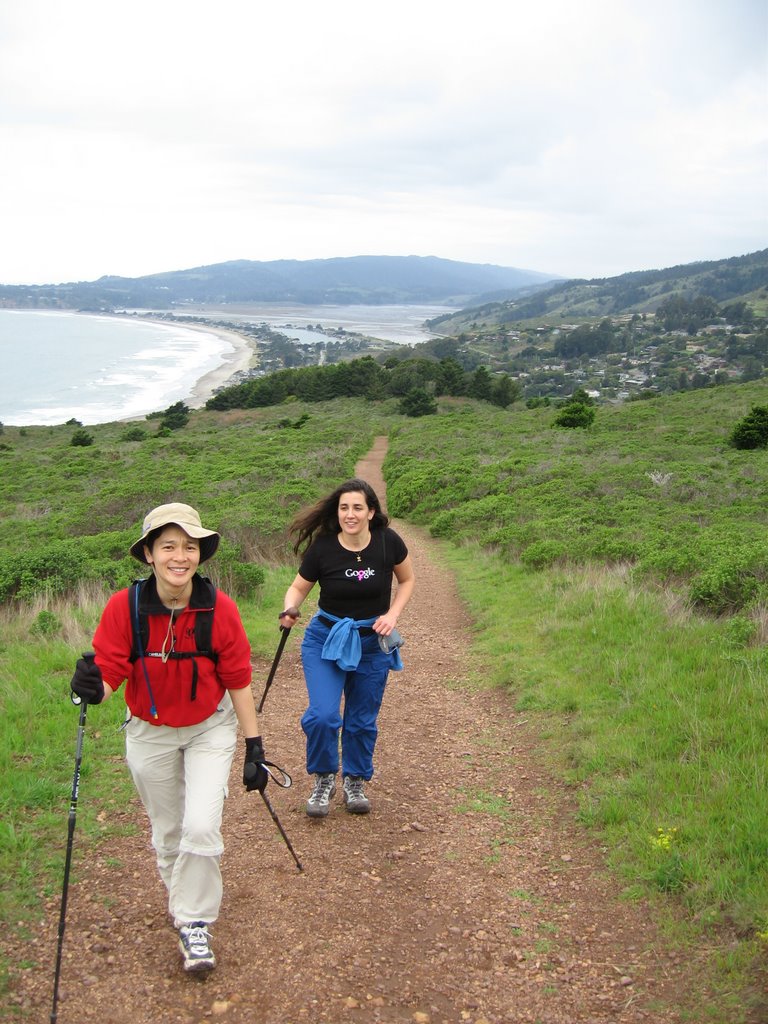
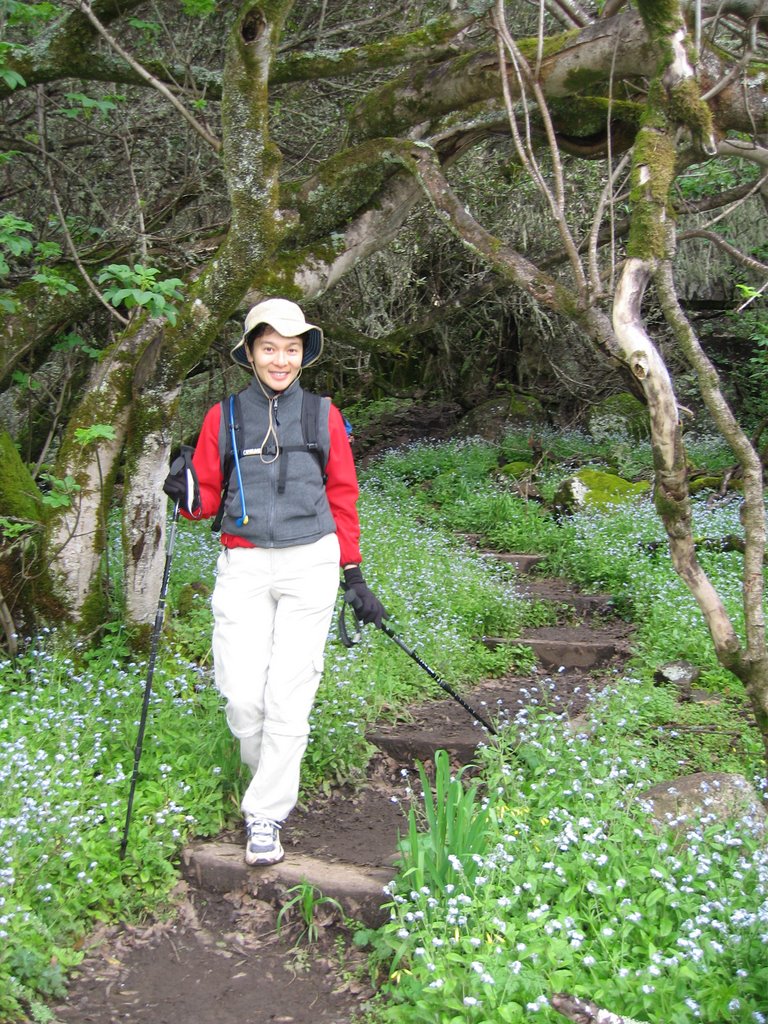
The Redwoods on Steep Ravine
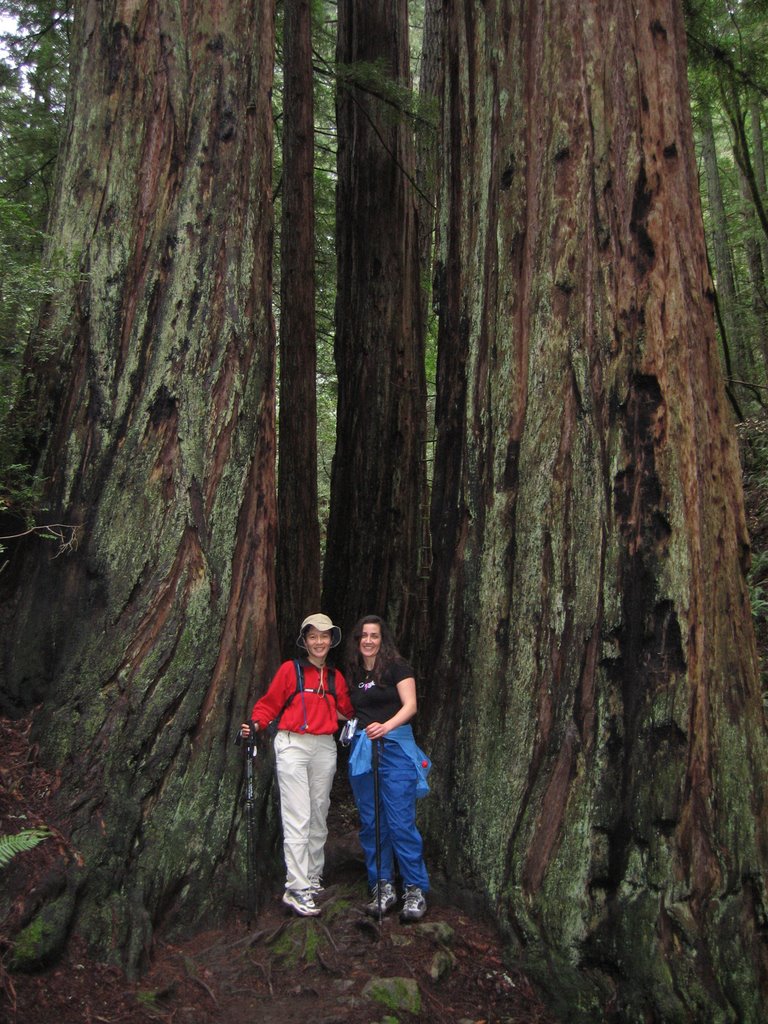 This was a fantastic time on Steep Ravine. So much water that the creeks and streams were gushing like jets, and the roar of the water was so loud we couldn't hear each other and had to shout!

Friday, March 31, 2006
Review: The Cosmic Landscape
Leonard Suskind is one of the co-inventors of string theory, but this book is not, strictly speaking, an explanation of string theory. Rather, Suskind uses the book as a platform to explain and evangelize the Anthropic Principle as an explanation of why the world we exist is the way it is.
What's wierd about modern physics is that it seems to be exceedingly complicated. Considering that up till the invention of quantum mechanics, all the physics that was known were really short and simple, this is a strange turn of events. Suskind deserves kudos for not attempting to oversimplify string theory, Feynman diagrams, or the strange world of quantum mechanics. In fact, he has one of the best explanations of Feynman diagrams I've read to date. His explanation of the many-worlds interpretation and the megaverse/multiverse is also thorough, fair-minded, and extremely well put. Science Fiction fans will find a lot to enjoy in this book.
Ultimately, though, my recent foray into modern physics is disappointing. There are no deep insights, no grand theories that explain anything. String theory itself makes no predictions:
Throughout this book I have dismissed beauty, uniqueness, and elegance as false mirages. The Laws of Physics (in the sense that I defined them in chapter 1) are neither unique nor elegant. It seems that the world, or our part of it, is a Rube Goldberg machine...
... I often joke that if the best theories are the ones with the minimum number of defining equations and principles, String Theory is by far the best --- no one has ever found even a single defining equation or principle! String Theory gives every indication of being a very elegant mathematical structure with a degree of consistency far beyond any other physical theory. But nobody knows what its defining rules are, nor does anyone know the basic "building blocks" are.
What's wierd about modern physics is that it seems to be exceedingly complicated. Considering that up till the invention of quantum mechanics, all the physics that was known were really short and simple, this is a strange turn of events. Suskind deserves kudos for not attempting to oversimplify string theory, Feynman diagrams, or the strange world of quantum mechanics. In fact, he has one of the best explanations of Feynman diagrams I've read to date. His explanation of the many-worlds interpretation and the megaverse/multiverse is also thorough, fair-minded, and extremely well put. Science Fiction fans will find a lot to enjoy in this book.
Ultimately, though, my recent foray into modern physics is disappointing. There are no deep insights, no grand theories that explain anything. String theory itself makes no predictions:
Throughout this book I have dismissed beauty, uniqueness, and elegance as false mirages. The Laws of Physics (in the sense that I defined them in chapter 1) are neither unique nor elegant. It seems that the world, or our part of it, is a Rube Goldberg machine...
... I often joke that if the best theories are the ones with the minimum number of defining equations and principles, String Theory is by far the best --- no one has ever found even a single defining equation or principle! String Theory gives every indication of being a very elegant mathematical structure with a degree of consistency far beyond any other physical theory. But nobody knows what its defining rules are, nor does anyone know the basic "building blocks" are.
Thursday, March 30, 2006
Review: Superman: Secret Identity
I seem to be on a Kurt Busiek binge lately. This little piece was a four part mini series focusing on the life of a Clark Kent who was teased as he was growing up and then discovers to his surprise that he does have the power of Superman. This is, of course, the ultimate adolescent fantasy, and Kurt Busiek is well aware of it and plays on it quite well. His aim, which he discloses in the foreward, was to use Superman as an icon to reflect on the various phases of a man's lifecycle, so he has this Superman age, so he deals with the problems of being an adult, becoming a father, having children, and then faced with losing his powers as he ages.
Overall, the topics are handled quite well, and the book is a good read, but rather lightweight. The topics are breezed through rather cursorily, though the art is gorgeous and lovely to look at. Recommended, but not nearly as insightful as Alan Moore's Miracleman. Read that first, if you can get a hold of it.
Overall, the topics are handled quite well, and the book is a good read, but rather lightweight. The topics are breezed through rather cursorily, though the art is gorgeous and lovely to look at. Recommended, but not nearly as insightful as Alan Moore's Miracleman. Read that first, if you can get a hold of it.
Sunday, March 26, 2006
2006 Book Reviews
If you're just looking for reading materials, I've recently posted the 2006 books of the year.
Fiction
Fiction
- The Algebraist
- Einstein's Dreams
- Ammonite
- The Merchant Princes Trilogy
- Coraline
- Singularity Sky
- Marooned in Realtime
- The Man Who Folded Himself
- The Curse of Chalion
- The Developers
- The Paladin of Souls
- The Hallowed Hunt
- A Long Way Down
- Anansi Boys
- Tomorrow Happens
- Accelerando
- Rainbow's End
- Hiding in the Mirror
- What's the matter with Kansas
- Unconventional Success
- Perfectly Legal
- The Cosmic Landscape
- Everything Bad is Good For You
- The Four Pillars of Investing
- Alan Moore's Writing for Comics
- The Undercover Economist
- The Two Income Trap
- The Pollysyllabic Spree
- The Omnivore's Dilemna
- Kingdom Coming
- Making Globalization Work
- Warped Passages
- The Long Tail
- The Way to Win
Review: The Algebraist, Iain M. Banks
Banks is not exactly a hard science fiction writer, even though his novels have a veneer of it. Typically, he leaves the hard science exposition really empty (unlike Stephen Baxter) and concentrates on the characters. In this book, however, he plays a joke on long time readers of his, and writes a book that is more mystery than science fiction or character exposition.
The main plot revolves around Fassin, a delver, a member of a class of scholars who have been privileged to interact directly or through telemetry with the denizens of his local system's gas giant, creatures who call themselves Dwellers. The Dwellers are a really long-lived species, dating back several billion years, but seem to have dropped themselves out of interacting with other species that they call "The Quick".
Several hundred years ago,Fassin accidentally discovered a piece of Dweller text that implies that the Dwellers have a secret wormhole network that permeates most star systems in the galaxy, and when word of that leaked out a war was started. Now Fassin must once again delve into the local gas giant and find the secret key to the wormhole network before invaders take over his home. The mystery to be solved by the reader is the nature of the wormhole network and what the key is. Clues are scattered throughout the novel, which has the structure of a repeated quest.
Distractions are provided through descriptions of a number of Fassin's friends and their relationship to him. This piece of misdirection worked incredibly well --- for instance, Banks spends page after page building up a particularly dastardly villain, only to dispatch him in less than a paragraph near the end of the book, which meant that I didn't concentrate on the mystery at all. There's no physics knowledge or higher mathematics needed to solve the mystery --- all the bits are provided there right in the book for you.
My only complain about the book, then, is that Banks needed to say, "Mystery! Mystery!" all over the frontipiece of the book instead of "Science Fiction!" Recommended, but I would not buy the hardback.
The main plot revolves around Fassin, a delver, a member of a class of scholars who have been privileged to interact directly or through telemetry with the denizens of his local system's gas giant, creatures who call themselves Dwellers. The Dwellers are a really long-lived species, dating back several billion years, but seem to have dropped themselves out of interacting with other species that they call "The Quick".
Several hundred years ago,Fassin accidentally discovered a piece of Dweller text that implies that the Dwellers have a secret wormhole network that permeates most star systems in the galaxy, and when word of that leaked out a war was started. Now Fassin must once again delve into the local gas giant and find the secret key to the wormhole network before invaders take over his home. The mystery to be solved by the reader is the nature of the wormhole network and what the key is. Clues are scattered throughout the novel, which has the structure of a repeated quest.
Distractions are provided through descriptions of a number of Fassin's friends and their relationship to him. This piece of misdirection worked incredibly well --- for instance, Banks spends page after page building up a particularly dastardly villain, only to dispatch him in less than a paragraph near the end of the book, which meant that I didn't concentrate on the mystery at all. There's no physics knowledge or higher mathematics needed to solve the mystery --- all the bits are provided there right in the book for you.
My only complain about the book, then, is that Banks needed to say, "Mystery! Mystery!" all over the frontipiece of the book instead of "Science Fiction!" Recommended, but I would not buy the hardback.
Friday, March 24, 2006
Rebalancing a Portfolio is hard...
So I finally sat down and systematically rebalanced my portfolio. From when I started to when I finished was about one and a half hours. My primary tools were Vanguard's web-site and Excel (any spreadsheet will do, but when you copy and paste a table from a web browser into Excel, it does the right thing and numbers stay numbers, which is very important for fast imports).
Vanguard offers a unified account consolidation view (including all your bank accounts, savings accounts etc), so when I selected and pasted that into Excel, I got all my financial data in one easy place (I don't trust my quicken accounts, since it's not completely up to date). I then create a table with my ideal asset allocation (I use the table provided at The Retire Early Home Page to set up my allocations).
After that, it's a matter of systematically assigning allocations to my existing investments, and adding up all my assets. (Don't forget to subtract your liabilities!) Then you figure out how far each asset class deviates from your ideal, and rebalance. In my case, there were a few items I didn't want to touch, so I over-rode my ideal allocation and went with something less than ideal (isn't that life?). For each asset class, you might want to sub-divide the allocation. (For instance, for domestic stocks, you might want to divide into small cap/mid cap/large cap, or for maximum convenience just use a "Total Stock Market Index")
Then another visit to the Vanguard web-site to perform the asset re-allocation.
A few things to watch out for:
Interestingly enough, if Vanguard is your employer's 401(k) manager, the on-line tool gives you a one-button rebalancing option (it rebalances to your 401(k) new money allocation, which is what you want if the 401(k) is your primary investment asset). That's very nice, but can't take into account your overall financial situation. Nevertheless, for those whose primary investment assets are in their 401(k) and are lucky enough to have Vanguard as the 401(k) trustee, it's a very nice button. Just push it and you're done! No spread-sheets, no tax consequences, and no hard thinking.
Vanguard offers a unified account consolidation view (including all your bank accounts, savings accounts etc), so when I selected and pasted that into Excel, I got all my financial data in one easy place (I don't trust my quicken accounts, since it's not completely up to date). I then create a table with my ideal asset allocation (I use the table provided at The Retire Early Home Page to set up my allocations).
After that, it's a matter of systematically assigning allocations to my existing investments, and adding up all my assets. (Don't forget to subtract your liabilities!) Then you figure out how far each asset class deviates from your ideal, and rebalance. In my case, there were a few items I didn't want to touch, so I over-rode my ideal allocation and went with something less than ideal (isn't that life?). For each asset class, you might want to sub-divide the allocation. (For instance, for domestic stocks, you might want to divide into small cap/mid cap/large cap, or for maximum convenience just use a "Total Stock Market Index")
Then another visit to the Vanguard web-site to perform the asset re-allocation.
A few things to watch out for:
- When allocating assets, if possible move stuff around in retirement accounts for the rebalancing. That allows your rebalancing to be tax-free to the largest extent possible.
- Consider the size of the re-allocation. If it's large enough, ETFs might make more sense than index funds. If it's too small, then mutual funds are more efficient.
- If you're going to take a loss from a re-allocation, depending on your circumstance, it might make sense to try to make it a long term loss rather than a short term loss, or vice-versa. (one tax management trick I've done in the past is to harvest a loss by exchanging one fund for another fund of the same asset class, thus staying invested while getting a capital loss for tax purposes --- but obviously, that's not as good as having lots of capital gains everywhere in your portfolio!) Note that such tax tricks are better off done closer to the end of the year when your overall tax picture is closer.
- Your tax situation should only dictate which particular vehicles you want to use for your asset classes, not which asset classes you want to be in.
Interestingly enough, if Vanguard is your employer's 401(k) manager, the on-line tool gives you a one-button rebalancing option (it rebalances to your 401(k) new money allocation, which is what you want if the 401(k) is your primary investment asset). That's very nice, but can't take into account your overall financial situation. Nevertheless, for those whose primary investment assets are in their 401(k) and are lucky enough to have Vanguard as the 401(k) trustee, it's a very nice button. Just push it and you're done! No spread-sheets, no tax consequences, and no hard thinking.
Wednesday, March 22, 2006
Trouble comes in threes
On Sunday, my network hard drive (a Ximeta NetDisk) died a horrible death, taking all the data on it with it. And of course, I did not have an adequate backup plan. So off to Fry's again, where I bought a replacement IDE drive for the Ximeta enclosure (which was fine and serves quite well) and an external USB drive to back up the Ximeta disk.
Then today, my laptop hard drive died. Fortunately, it's a corporate machine so it's backed up by IT (I think!).
Finally, on my way home, I got a flat. Let's hope that's the end of my troubles this time.
Then today, my laptop hard drive died. Fortunately, it's a corporate machine so it's backed up by IT (I think!).
Finally, on my way home, I got a flat. Let's hope that's the end of my troubles this time.
Tuesday, March 21, 2006
Review: Hiding in the Mirror
Laurence Krauss wrote The Physics of Star Trek, which despite its lightweight nature, was good reading and accurate. This book, a non-technical treatise on string theory and superstring theory, is a good enough book for someone with very little understanding of Physics or Mathematics, but unfortunately, string theory and all of its variations are such a complex subject that I barely gained an understanding of what it was by the end of the book.
The first half of the book is about dimensionality, which includes one of the best explanations of Einstein's theory of relativity in layman's form that I have read. This part is easy going and a good refresher even for those of us who've covered the material before. The second half bogs down in attempts to explain Mathematical concepts in English, which of course is very hard, especially since string theory appears to be an entirely mathematical concept --- there has not been any successful attempts to prove it correct or wrong, which means that the theory has made no useful predictions. Of course, that doesn't mean it's not elegant mathematics, but it does mean that it's an incomplete story. I hope Krauss is around to explain the story when the Physicists finally figure it out one way or another.
The first half of the book is about dimensionality, which includes one of the best explanations of Einstein's theory of relativity in layman's form that I have read. This part is easy going and a good refresher even for those of us who've covered the material before. The second half bogs down in attempts to explain Mathematical concepts in English, which of course is very hard, especially since string theory appears to be an entirely mathematical concept --- there has not been any successful attempts to prove it correct or wrong, which means that the theory has made no useful predictions. Of course, that doesn't mean it's not elegant mathematics, but it does mean that it's an incomplete story. I hope Krauss is around to explain the story when the Physicists finally figure it out one way or another.
Saturday, March 18, 2006
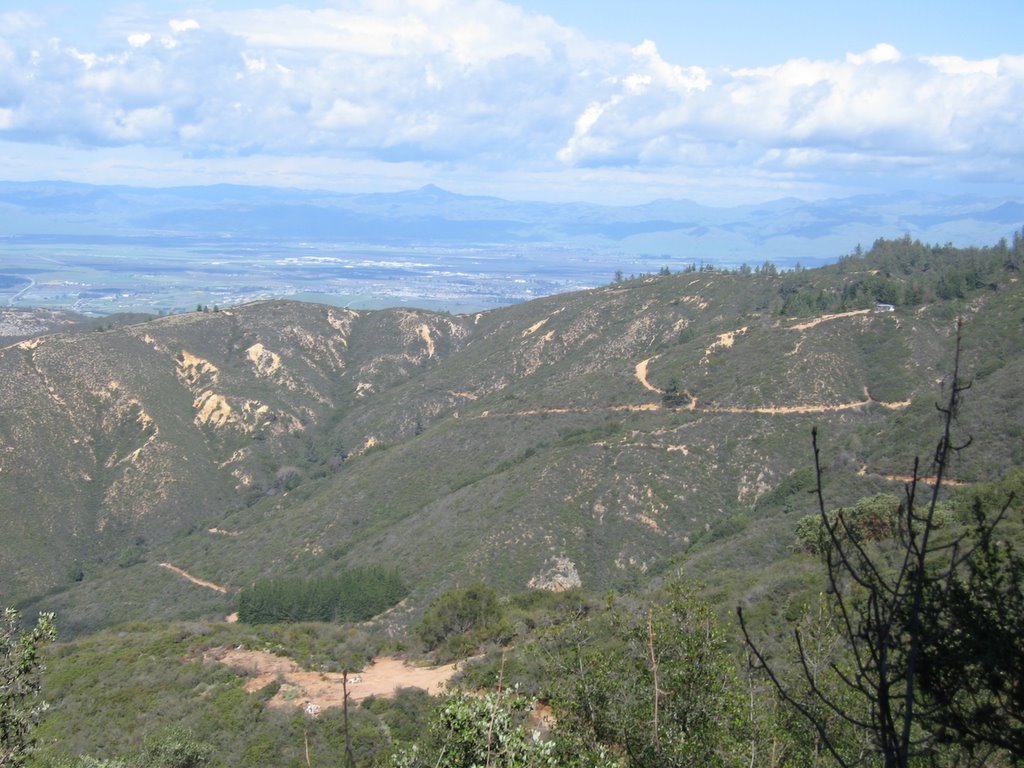
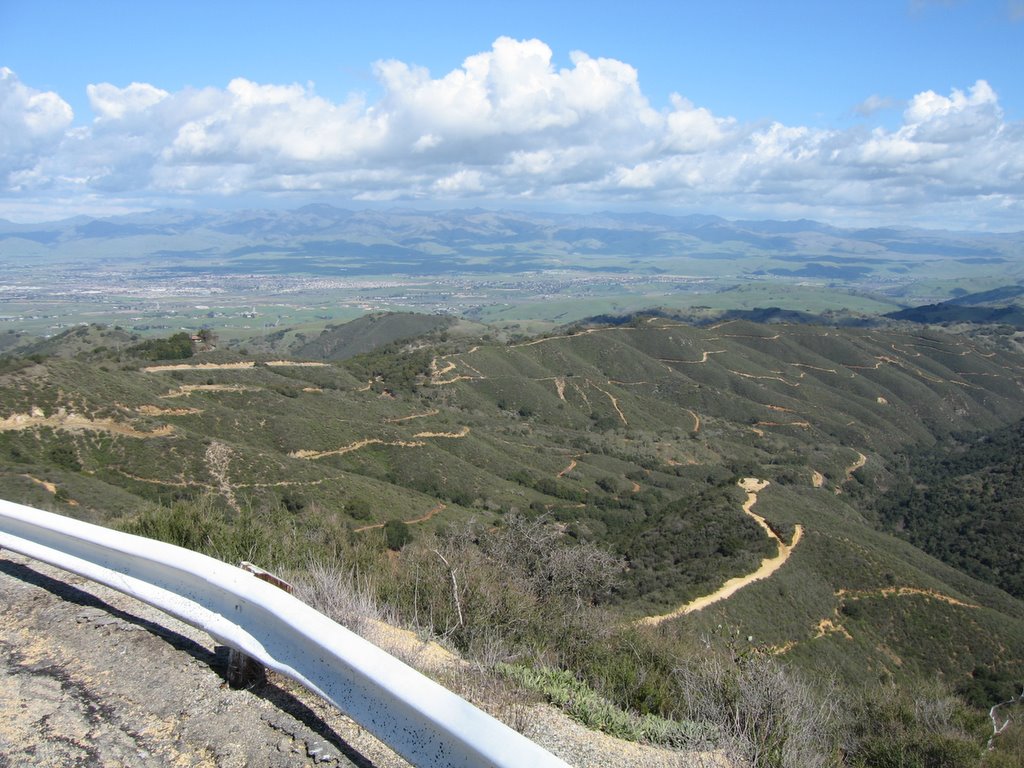


Monday, March 13, 2006
Snow on Serra Azul
 It was supposed to be snow at 500' on the night of the 12th, so Lisa & I hiked up to see it! It was pretty warm as we hiked, with rain coming down, so we expected to be disappointed, but indeed there was plenty of snow!
Sunday, March 05, 2006
Saturday's Ride
It had snowed the day before, so Roberto Peon, Mike Samuel and I decided to go see if we could see some up close on Diablo. Roberto, in particular, had acquired a nice carbon Fuji and wanted to see how it would do on some substantial climbs. There was some confusion with the meeting point and I had an inexplicable flat front tire in the parking lot at Diablo Vista Park, but with everything ready we got rolling by 10:30.
The ride to the South entrance if Diablo State Park was enough to get us warmed up, and the climb up Mt. Diablo Scenic Drive soon led us to glorious vistas of the area below: San Ramon and its environs. The day was clear and there was very little mist in the air. To my chagrin I realized that in all the excitement to get going I had left my camera at home! We saw a bit of snow near the peaks, but it didn’t look like it was completely covered in snow. We rode along at a good clip, and as we passed the entrance station we saw a sign that said the road was closed at the Juniper campground.
At the junction, we stopped and rested and ate a little bit before turning right and up towards the summit. Traffic was quite heavy, probably because there were others with the same ideas we had, but wanted to drive up as far as they could. In 2 miles we arrived at the Juniper campground and sure enough, it was closed. The road closed sign was evidently traversable by bicycle but with 2 rangers watching me I did not feel like blatantly ignoring the sign, so we refilled out water-bottles, put on and started rolling down the hill. As I got near the junction road, I saw a steep path leading off from the main road and two men climbing it, one wearing suspenders. I knew it had to be none other than Grant Petersen, so I shouted out his name and rolled up the path.
Grant stopped and I introduced my companions. He was test riding the new 650B tires (I forgot the name: Lumpy Frumpy?), and they definitely looked hefty enough for serious trail riding, with a dimpled tread pattern. We chatted a bit and he asked me why I wasn’t at the handmade bike show in San Jose. I had forgotten all about that show, but in any case would rather be riding bikes than looking at them. I mentioned that we were going to ride Morgan Territory road, and Grant’s companion said, “Good for you!” in a tone of voice that made Roberto and Mike say, “Great. Now we know we’re in for it!” I told Grant about the road closure, and he said that the rangers wouldn’t have fined us even if we had made an illegal run up the mountain. Oh well. I asked Roberto and Mike if they felt like going back up there, and the consensus seemed to be that we had plenty more climbing ahead of us, so we said goodbye to the Rivendellers and headed down the hill.
Roberto had great fun with his new bike on the descent, and proclaimed it excellent as he rolled and rolled up and down some of the rollers. Soon enough we were in Walnut Creek and made the right turn onto the Contra-Costa County bike trail, which we took over to Treat Blvd and Turtle Creek road. As we approached the town of Clayton, Roberto got a front flat, and discovered a torn in his tire. He took a look at the inner tube of his front wheel and decided that the rubber was so thin that it was just looking for an excuse to puncture, so he put in a new one and threw away the other.
Soon enough, we were in Clayton where we had lunch outside at the Grill. Around us I could see clouds start to gather as the temperature dropped. After a too-heavy-for-me lunch, we started down Marsh Creek road again, which made its way up a hill to get over to the ridge where Morgan Territory road started. I definitely felt the lunch work its way into my stomach, so perhaps Marsh Creek road wasn’t surprisingly steep. Having climbed it on a tandem only, I didn’t think it would be as painful on a single, but apparently it’s not the road, it must always have been the excess food in my stomach.
Traffic on Marsh Creek road was heavy, and it was a relief when the descent started and led us at the bottom to Morgan Territory road where we could relax and breath for a bit. Morgan Territory road starts out as being a few farms and houses and then plunges down to alongside a creek and turned into a road that was narrow (single-lane only), rough, and debris-laden. Nevertheless, the sound of the creek was lovely (I had never seen it so full), and the road as pleasant to ride as ever.
We rolled along a little bit at a gentle pace but soon enough, Roberto felt a bit of vim in started turning up the speed. It took everything I had to stay with him, but as he turned a steep corner I dug down and found nothing, so decided to let him go ahead. After a few corners I saw him again, but he had just passed a truck parked alongside the road and the driver was shooting pictures, so I posed a bit. As I passed I asked him if the camera was digital and he said “yes.” So I turned around and went back to him to provide an e-mail address so he could e-mail me photos. We chatted a bit and he mentioned that Mike was a distance behind me, but I had no doubt he would catch up. I took my leave of Brian Daniels and went after Roberto with little motivation.
It didn’t take long, however, before I spotted him waiting at the entrance to the Morgan Territory Regional Preserve parking lot. He told me he waited for 4 or 5 minutes and looked very happy. It didn’t take long before Mike showed up. “We’re not far from the top now, and we’ll stop there to put on clothes.” “Is it a bad descent?” “No, it’s straight and long, but the feeling of falling out of the sky always makes me nervous.”
What I was unprepared for, however, was the views. The wind had swept away all clouds while we were climbing, and we could see as far as the windmills of Livermore and the Bay. It looked stunning by the light of the mid-afternoon sun, and I wished I had brought my camera. The descent along the twisty road with lots of blind corners and a single lane wasn’t excessively fast, but had a dreamy, flight-like quality along the smooth road with very little wind. Roberto took off like a rocket as soon as the road started developing rollers, and Mike said to me, “You’ve created a monster.” “Indeed, on his new bike, he climbs fast, descends fast, and rolls fast on the flat!”
We regrouped at the bottom of Morgan Territory road, turned onto Manning and Highland roads, and rolled the remaining miles through beautiful pastoral country side with light coming through partly cloudy skies. All in all, it was a great ride with 63 miles and about 5000’ of climbing.
The ride to the South entrance if Diablo State Park was enough to get us warmed up, and the climb up Mt. Diablo Scenic Drive soon led us to glorious vistas of the area below: San Ramon and its environs. The day was clear and there was very little mist in the air. To my chagrin I realized that in all the excitement to get going I had left my camera at home! We saw a bit of snow near the peaks, but it didn’t look like it was completely covered in snow. We rode along at a good clip, and as we passed the entrance station we saw a sign that said the road was closed at the Juniper campground.
At the junction, we stopped and rested and ate a little bit before turning right and up towards the summit. Traffic was quite heavy, probably because there were others with the same ideas we had, but wanted to drive up as far as they could. In 2 miles we arrived at the Juniper campground and sure enough, it was closed. The road closed sign was evidently traversable by bicycle but with 2 rangers watching me I did not feel like blatantly ignoring the sign, so we refilled out water-bottles, put on and started rolling down the hill. As I got near the junction road, I saw a steep path leading off from the main road and two men climbing it, one wearing suspenders. I knew it had to be none other than Grant Petersen, so I shouted out his name and rolled up the path.
Grant stopped and I introduced my companions. He was test riding the new 650B tires (I forgot the name: Lumpy Frumpy?), and they definitely looked hefty enough for serious trail riding, with a dimpled tread pattern. We chatted a bit and he asked me why I wasn’t at the handmade bike show in San Jose. I had forgotten all about that show, but in any case would rather be riding bikes than looking at them. I mentioned that we were going to ride Morgan Territory road, and Grant’s companion said, “Good for you!” in a tone of voice that made Roberto and Mike say, “Great. Now we know we’re in for it!” I told Grant about the road closure, and he said that the rangers wouldn’t have fined us even if we had made an illegal run up the mountain. Oh well. I asked Roberto and Mike if they felt like going back up there, and the consensus seemed to be that we had plenty more climbing ahead of us, so we said goodbye to the Rivendellers and headed down the hill.
Roberto had great fun with his new bike on the descent, and proclaimed it excellent as he rolled and rolled up and down some of the rollers. Soon enough we were in Walnut Creek and made the right turn onto the Contra-Costa County bike trail, which we took over to Treat Blvd and Turtle Creek road. As we approached the town of Clayton, Roberto got a front flat, and discovered a torn in his tire. He took a look at the inner tube of his front wheel and decided that the rubber was so thin that it was just looking for an excuse to puncture, so he put in a new one and threw away the other.
Soon enough, we were in Clayton where we had lunch outside at the Grill. Around us I could see clouds start to gather as the temperature dropped. After a too-heavy-for-me lunch, we started down Marsh Creek road again, which made its way up a hill to get over to the ridge where Morgan Territory road started. I definitely felt the lunch work its way into my stomach, so perhaps Marsh Creek road wasn’t surprisingly steep. Having climbed it on a tandem only, I didn’t think it would be as painful on a single, but apparently it’s not the road, it must always have been the excess food in my stomach.
Traffic on Marsh Creek road was heavy, and it was a relief when the descent started and led us at the bottom to Morgan Territory road where we could relax and breath for a bit. Morgan Territory road starts out as being a few farms and houses and then plunges down to alongside a creek and turned into a road that was narrow (single-lane only), rough, and debris-laden. Nevertheless, the sound of the creek was lovely (I had never seen it so full), and the road as pleasant to ride as ever.
We rolled along a little bit at a gentle pace but soon enough, Roberto felt a bit of vim in started turning up the speed. It took everything I had to stay with him, but as he turned a steep corner I dug down and found nothing, so decided to let him go ahead. After a few corners I saw him again, but he had just passed a truck parked alongside the road and the driver was shooting pictures, so I posed a bit. As I passed I asked him if the camera was digital and he said “yes.” So I turned around and went back to him to provide an e-mail address so he could e-mail me photos. We chatted a bit and he mentioned that Mike was a distance behind me, but I had no doubt he would catch up. I took my leave of Brian Daniels and went after Roberto with little motivation.
It didn’t take long, however, before I spotted him waiting at the entrance to the Morgan Territory Regional Preserve parking lot. He told me he waited for 4 or 5 minutes and looked very happy. It didn’t take long before Mike showed up. “We’re not far from the top now, and we’ll stop there to put on clothes.” “Is it a bad descent?” “No, it’s straight and long, but the feeling of falling out of the sky always makes me nervous.”
What I was unprepared for, however, was the views. The wind had swept away all clouds while we were climbing, and we could see as far as the windmills of Livermore and the Bay. It looked stunning by the light of the mid-afternoon sun, and I wished I had brought my camera. The descent along the twisty road with lots of blind corners and a single lane wasn’t excessively fast, but had a dreamy, flight-like quality along the smooth road with very little wind. Roberto took off like a rocket as soon as the road started developing rollers, and Mike said to me, “You’ve created a monster.” “Indeed, on his new bike, he climbs fast, descends fast, and rolls fast on the flat!”
We regrouped at the bottom of Morgan Territory road, turned onto Manning and Highland roads, and rolled the remaining miles through beautiful pastoral country side with light coming through partly cloudy skies. All in all, it was a great ride with 63 miles and about 5000’ of climbing.
Piaw on Morgan Territory road
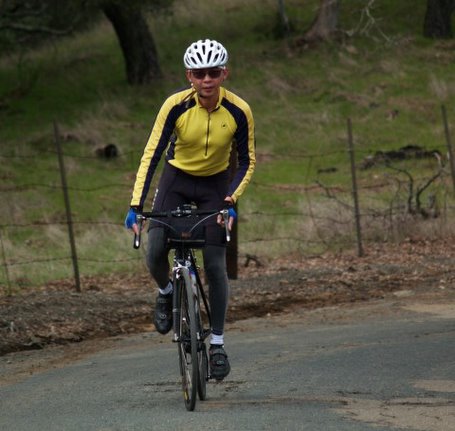 Here I am, a few seconds later. I'd noticed the photographer, so I tried to look more comfortable.
Photo Credit: Brian Daniels
Roberto Climbing Morgan Territory Road

Here's Roberto climbing Morgan Territory Road on March 4th. He looks a little tired here, but he was kicking my ass!
Photo Credit: Brian Daniels
Wednesday, March 01, 2006
Ok, now I need a gtags intern
I previously mentioned that I already had a summer intern for 2006. Well, my intern accepted a full-time offer at Google, so now she's not going to be my intern but will be a colleague instead (yay!). Which leaves me still wanting an intern for gtags for summer 2006. If you're interested in working on gtags, please send me e-mail (or post in the comments with contact information). If you've already submitted your resume through the google intern application process, please just note your name and I'll work the internal system and try to schedule you for an interview. (No promises: if your resume doesn't look good to me, then you won't get an interview or call back)
Sunday, February 26, 2006
Review: Local Heroes, Kurt Busiek
Kurt Busiek's Astro City is a post-modernist take on super-heroes, the quintessential American mythos. He relies very much on your latent knowledge of super-heroes, and populates Astro City with clones and derivatives of them --- the Superman clone, the Batman identico, the speedster, and all the correspondent types. His approach is unique in that he does not discuss their abilities and their origins (except in one case, and that was only to provide an interesting perspective on his version of Batman). Instead, he takes the oblique view, providing a look at the heroes from a small, limited perspective.
This collection starts off with the point of view of a doorman at a local hotel, and then rapidly cycles through a host of ordinary people, including a comic book writer, a retired hero, an attorney, a ex-superhero's girlfriend, and a young girl who leaves Astro City for the first time to visit her countryside relatives. Each of the stories come with a little twist, and each tale revolves somehow around a superhero, but from the perspective of an ordinary person. The art is well done and consistent.
Overall, the series and the book is recommended. Kurt Busiek is no Alan Moore in the early nineties, but he is the equal to Moore's current series of books.
This collection starts off with the point of view of a doorman at a local hotel, and then rapidly cycles through a host of ordinary people, including a comic book writer, a retired hero, an attorney, a ex-superhero's girlfriend, and a young girl who leaves Astro City for the first time to visit her countryside relatives. Each of the stories come with a little twist, and each tale revolves somehow around a superhero, but from the perspective of an ordinary person. The art is well done and consistent.
Overall, the series and the book is recommended. Kurt Busiek is no Alan Moore in the early nineties, but he is the equal to Moore's current series of books.
Tuesday, February 21, 2006
Review: What's the Matter with Kansas
This book was all over the political press last year, and frequently cited as a good explanation of why the Democrats keep losing election despite having a much better platform, much better track record of governing, and much more palatable policies.
Written in a style that's sarcastic (that's "witty" for some people), and not without more than a little bitterness, Thomas Frank first provides a short synopsis of Kansas history. Kansas in the 1890s was a bastion of left-winged politicians and reliably Democratic. The shift to conservatism, Frank writes, mostly occured in the 80s and 90s, and is driven largely by culture warriors, not economics.
Franks provides a history of the religious radical right and its seeds in the anti-abortion movement, which was quickly seized upon as a platform to build a far right largely oriented around cultural issues while mostly centered around (in policy) tax cuts for the rich. He interviews interesting folks such as Kay O'Connor, who is not your typical fat-cat Republican, but a relatively low-income person who wishes to "turn back the clock" on cultural issues:
"I'm a happy captive of forty-three years," she tells me, "and I am obedient to my husband in all things moral."
On economic issues, O'Connor says:
"Why should we be penalizing people for being financially successful?" she asks. "When you take from the rich and give to the poor, that really is Robin Hood, and that's just theft. Robin Hood was a thief."
Franks explains that the culture wars can never really be won by the right, since political victories can't do much to change culture (which is largely provided by the entertainment industry), and so these repeated failures to win the culture wars keep the right extremely riled up, despite winning all three branches of the government. It's difficult, for instance, to push creationism in public school, but each loss in the courts only serves to spur the religious right into another frenzy of political activity.
It is only in the epilogue that Franks comes down on the Democrats:
The Democratic Leadership Council (DLC), the organization that produced such figures as Bill Clinton, Al Gore, Joe Lieberman, and Terry McAuliffe, has long been pushing the party to forget blue-collar voters and concentrate instead on recruiting affluent, white-collar professionals who are liberal on social issues... As for the working-class voters who were until recently the party's very backbone, the DLC figures they will have nowhere else to go... Besides, what politician in this sucvess-worshiping country really wants to be the voice of poor people? Where's the soft money in that?
To a large extent he is over-simplifying the issue. Bill Clinton's economic policies were by and large, well-informed, and served the poor well, despite also being good for the wealthy. Free trade does do a lot of good for the poor, despite a lot of hand-wringing from the left. Having said that, I understand where Franks is coming from. In a political environment where the losers from free trade feel enormous hardship without wage insurance or other mitigating factors, I cannot imagine a blue collar worker who cares about his self-interest voting for a free-trading Democrat. To my mind, the charge that "there's no difference between the Democrats and the Republicans" stem largely from the free trade agreements that have been signed by both parties when they were in power without any mitigating policies to help protect the losers whatsoever.
I'm a believer in free trade and its ability to not just help the poor in the US, but the poor in all parts of the world as well. But if you asked me to choose between fiscal responsibility, protecting the environment, providing a reasonable social safety net and a national healthcare system that works and free trade, I'm happy to flush free trade down the toilet any time. The big mistake that the Democrats have made is not realizing that political tradeoff, and with the large decline in labor union, it may never recover. While Clinton's policies were very sane, I think that a largely uneducated population that gets all its news from TV (and Fox News) will never be able to understand why his policies worked as well as they did (yes, he was lucky, but he also had policies that capitalized on his luck), and will only remember him for his relationship with a certain intern.
But the alternative, that the right-wing Republicans capture power for all time is even more scary. A USA where the schools teach creationism isn't going to be fun, even if you're rich. Laws that revoke women's right to votes, ban women from the workplace will make America a poorer place, in spirit and in reality. Research will grind to a halt, and the innovation spurts we are used to seeing will be gone. Fortunately, there will be a backlash before it goes that far (I hope).
In the mean time, I think (as Franks wrote) that I can find it in myself to enjoy the deep tax cuts for the well-to-do that the religious right has forced down my throat to the detriment of themselves and their children.
Written in a style that's sarcastic (that's "witty" for some people), and not without more than a little bitterness, Thomas Frank first provides a short synopsis of Kansas history. Kansas in the 1890s was a bastion of left-winged politicians and reliably Democratic. The shift to conservatism, Frank writes, mostly occured in the 80s and 90s, and is driven largely by culture warriors, not economics.
Franks provides a history of the religious radical right and its seeds in the anti-abortion movement, which was quickly seized upon as a platform to build a far right largely oriented around cultural issues while mostly centered around (in policy) tax cuts for the rich. He interviews interesting folks such as Kay O'Connor, who is not your typical fat-cat Republican, but a relatively low-income person who wishes to "turn back the clock" on cultural issues:
"I'm a happy captive of forty-three years," she tells me, "and I am obedient to my husband in all things moral."
On economic issues, O'Connor says:
"Why should we be penalizing people for being financially successful?" she asks. "When you take from the rich and give to the poor, that really is Robin Hood, and that's just theft. Robin Hood was a thief."
Franks explains that the culture wars can never really be won by the right, since political victories can't do much to change culture (which is largely provided by the entertainment industry), and so these repeated failures to win the culture wars keep the right extremely riled up, despite winning all three branches of the government. It's difficult, for instance, to push creationism in public school, but each loss in the courts only serves to spur the religious right into another frenzy of political activity.
It is only in the epilogue that Franks comes down on the Democrats:
The Democratic Leadership Council (DLC), the organization that produced such figures as Bill Clinton, Al Gore, Joe Lieberman, and Terry McAuliffe, has long been pushing the party to forget blue-collar voters and concentrate instead on recruiting affluent, white-collar professionals who are liberal on social issues... As for the working-class voters who were until recently the party's very backbone, the DLC figures they will have nowhere else to go... Besides, what politician in this sucvess-worshiping country really wants to be the voice of poor people? Where's the soft money in that?
To a large extent he is over-simplifying the issue. Bill Clinton's economic policies were by and large, well-informed, and served the poor well, despite also being good for the wealthy. Free trade does do a lot of good for the poor, despite a lot of hand-wringing from the left. Having said that, I understand where Franks is coming from. In a political environment where the losers from free trade feel enormous hardship without wage insurance or other mitigating factors, I cannot imagine a blue collar worker who cares about his self-interest voting for a free-trading Democrat. To my mind, the charge that "there's no difference between the Democrats and the Republicans" stem largely from the free trade agreements that have been signed by both parties when they were in power without any mitigating policies to help protect the losers whatsoever.
I'm a believer in free trade and its ability to not just help the poor in the US, but the poor in all parts of the world as well. But if you asked me to choose between fiscal responsibility, protecting the environment, providing a reasonable social safety net and a national healthcare system that works and free trade, I'm happy to flush free trade down the toilet any time. The big mistake that the Democrats have made is not realizing that political tradeoff, and with the large decline in labor union, it may never recover. While Clinton's policies were very sane, I think that a largely uneducated population that gets all its news from TV (and Fox News) will never be able to understand why his policies worked as well as they did (yes, he was lucky, but he also had policies that capitalized on his luck), and will only remember him for his relationship with a certain intern.
But the alternative, that the right-wing Republicans capture power for all time is even more scary. A USA where the schools teach creationism isn't going to be fun, even if you're rich. Laws that revoke women's right to votes, ban women from the workplace will make America a poorer place, in spirit and in reality. Research will grind to a halt, and the innovation spurts we are used to seeing will be gone. Fortunately, there will be a backlash before it goes that far (I hope).
In the mean time, I think (as Franks wrote) that I can find it in myself to enjoy the deep tax cuts for the well-to-do that the religious right has forced down my throat to the detriment of themselves and their children.
Monday, February 20, 2006
Figure skating: Sport or Art?
Dan Engber complains that figure skating has become a video game:
Here's how the new scoring system works: A technical specialist identifies each move that a skater performs, and assigns to it a level of difficulty. Then the judges rate each of those moves with a "grade of execution." To compute a skater's total score, get out your "scale of value" chart and cross-reference the move, its level, and its grade. For example, you'd get 7.5 points for completing a basic triple axel. A perfect triple axel earns a couple more points, and a lousy one a couple fewer.
With such explicit scoring rules, skaters have learned to pad their numbers. A brief look at the chart reveals that a string of fancy moves done badly is worth a whole lot more than a string of simple moves done with grace and élan. What about tumbling on your ass? According to the rules, a fall on a jump automatically gets you the lowest grade. (Every fall also earns you a one-point deduction.) But if the jump is fancy enough, that low grade will still be worth big points...
There are required elements, of course, and limits to the number of jumps you're allowed to attempt. But skaters who know the system can treat it like a video game, stringing together fancy combos so they can rack up a high score.
And you know what, I actually think that's a feature! I don't watch figure skating myself (no TV, and no real interest, thank you very much), but to me, that's the difference between sport and art. Art should be flawless and look good, but sport should be about atheleticism, ability to perform on the event, with bounded rules and as much as possible, no subjective judgement necessary.
In a running race, nobody scores points for style --- it's whoever crosses the finish line first, even if he was the ugliest person since Humphrey Bogart. If figure skating wants to be an Olympic sport, it shouldn't be any different otherwise, it's not a sport, and should be thrown out of the Olympics. I don't understand why anyone should complain about the new rules for figure skating. To my mind, if the rules don't encourage risk-taking and achievement of the hardest possible jumps and stunts, then the rules would not be congruent with the spirit of the Olympics.
Here's how the new scoring system works: A technical specialist identifies each move that a skater performs, and assigns to it a level of difficulty. Then the judges rate each of those moves with a "grade of execution." To compute a skater's total score, get out your "scale of value" chart and cross-reference the move, its level, and its grade. For example, you'd get 7.5 points for completing a basic triple axel. A perfect triple axel earns a couple more points, and a lousy one a couple fewer.
With such explicit scoring rules, skaters have learned to pad their numbers. A brief look at the chart reveals that a string of fancy moves done badly is worth a whole lot more than a string of simple moves done with grace and élan. What about tumbling on your ass? According to the rules, a fall on a jump automatically gets you the lowest grade. (Every fall also earns you a one-point deduction.) But if the jump is fancy enough, that low grade will still be worth big points...
There are required elements, of course, and limits to the number of jumps you're allowed to attempt. But skaters who know the system can treat it like a video game, stringing together fancy combos so they can rack up a high score.
And you know what, I actually think that's a feature! I don't watch figure skating myself (no TV, and no real interest, thank you very much), but to me, that's the difference between sport and art. Art should be flawless and look good, but sport should be about atheleticism, ability to perform on the event, with bounded rules and as much as possible, no subjective judgement necessary.
In a running race, nobody scores points for style --- it's whoever crosses the finish line first, even if he was the ugliest person since Humphrey Bogart. If figure skating wants to be an Olympic sport, it shouldn't be any different otherwise, it's not a sport, and should be thrown out of the Olympics. I don't understand why anyone should complain about the new rules for figure skating. To my mind, if the rules don't encourage risk-taking and achievement of the hardest possible jumps and stunts, then the rules would not be congruent with the spirit of the Olympics.
Review: Shock Rockets
Kurt Busiek first came to my attention through his conception of Astro City, a neo-superhero world that takes a respectful view of the super-hero genre while providing a fresh take on it. (His "Batman" character, for instance, has a secret that was both original and interesting)
Shock Rockets is his attempt at juvenile science fiction, similar to John Varley's Red Thunder. It features a world where Earth survives an alien assault by stealing enough alien fighter planes to turn the tide. Only 6 of those planes survive the war, and are now used to maintain peace in the post-invasion world.
The story starts with a disenchanted kid who accidentally ends up piloting one of the rockets when the pilot dies (with only the slightest tip of the hat to Abin-Sur handing over his ring to Hal Jordan). He then starts to discover that the ships and his world aren't quite what they seem to be on the surface.
The story deals with many interesting social themes, from class resentment to team integration. The slow reveal of the story behind the ships and the world behind the story is also skillfully done, and the art is excellent. The end of this volume provides a plot revelation that obviously leaves plenty of room for sequels, which I hope will be as interesting as this first book.
Recommended.
Shock Rockets is his attempt at juvenile science fiction, similar to John Varley's Red Thunder. It features a world where Earth survives an alien assault by stealing enough alien fighter planes to turn the tide. Only 6 of those planes survive the war, and are now used to maintain peace in the post-invasion world.
The story starts with a disenchanted kid who accidentally ends up piloting one of the rockets when the pilot dies (with only the slightest tip of the hat to Abin-Sur handing over his ring to Hal Jordan). He then starts to discover that the ships and his world aren't quite what they seem to be on the surface.
The story deals with many interesting social themes, from class resentment to team integration. The slow reveal of the story behind the ships and the world behind the story is also skillfully done, and the art is excellent. The end of this volume provides a plot revelation that obviously leaves plenty of room for sequels, which I hope will be as interesting as this first book.
Recommended.
Review: Akira
I saw Akira the movie several years ago, and it felt like a movie made from a book --- the movie didn't quite make sense, despite the technical virtuosity behind it (the voices from the child actors were recorded first, then the animation drawn to match the voices). It reminded me quite a bit of 2001: A Space Odyssey, a movie that did not make sense to me until I read the Arthur C. Clarke novelization (which apparently was written while the movie was filmed).
So when I went to the source, I hoped that it would be coherent and sophisticated. Unfortunately, it seemed that while the movie did not encompass all the plot points (the romance beteen Kaneda and Kei was removed with the character of Kei being eliminated from the movie, for instance), it held true to the spirit of the manga --- lots of explosions, an inexplicable plot, with no "science" whatsoever behind the fiction. The ending was unsatisfying as well.
All in all, not recommended.
So when I went to the source, I hoped that it would be coherent and sophisticated. Unfortunately, it seemed that while the movie did not encompass all the plot points (the romance beteen Kaneda and Kei was removed with the character of Kei being eliminated from the movie, for instance), it held true to the spirit of the manga --- lots of explosions, an inexplicable plot, with no "science" whatsoever behind the fiction. The ending was unsatisfying as well.
All in all, not recommended.
President's Day Ride
I wanted to see if there was any snow left on Skyline, two days after a once a decade snowfall in the Bay Area. I climbed Pierce Road and Highway 9 with no trouble, seeing no other cyclists except a mountain biker on Pierce Road who turned off towards the reservoir. The amount of car traffic was considerable, however, indicating that many folks had the same idea I did. The weather was warm, prompting thoughts that the snow might all be gone already.
A left turn on Skyline Blvd brought further climbing and the temperature rapidly dropped under the shade of pine trees. I stopped at an open space to check out the visibility --- unfortunately, it was not clear to the coast --- a light haze filled the air and I could not see the Big Sur coastline hidden in the clouds.
As I approached Castle Rock State Park, I started seeing patches of residual ice on the roadside. The road surface became sandy and grimy and quite wet. As I approached Castle Rock, I observed that the parking lot was full. Sure enough, there were kids throwing snowballs at each other! The tree branches above me were still laden with snow, the melting of which caused droplets of water to fall on the road (and on me). There was a crackling in the air as pieces of ice broke off from the snow clumps and landed onto the road. I stopped for a couple of pictures and then moved on.
Past Castle Rock, the road began a rapid descent, but out of the corner of my eye, I could see that the Christmas Tree farm along Skyline was inundated with snow in its open spots. The descent on Skyline is normally enjoyable and fast, but with the road surface dark and wet, I did not want to risk running over any black-ice and kept my speed down. About a mile from the Black road intersection all traces of ice and snow went away and I could relax again and enjoy the open scenery all around me.
Past Black road, Skyline Blvd becomes a one lane road that has relatively light traffic but many blind corners, which I took prudently despite the lack of motor-traffic since Castle Rock. The reason for this lack of traffic became apparently when I ran up to a "Road Closed" sign. It looked like a minor bit of construction, so I walked my bike around the sign and through the construction. The construction was muddy, and some small stones got wedged in between my brakes and the rim, but a bit of extra water and a stick used as a scraper solved that problem.
Except for an unusual amount of traffic down Bear Creek road, the rest of the ride was uneventful.
A left turn on Skyline Blvd brought further climbing and the temperature rapidly dropped under the shade of pine trees. I stopped at an open space to check out the visibility --- unfortunately, it was not clear to the coast --- a light haze filled the air and I could not see the Big Sur coastline hidden in the clouds.
As I approached Castle Rock State Park, I started seeing patches of residual ice on the roadside. The road surface became sandy and grimy and quite wet. As I approached Castle Rock, I observed that the parking lot was full. Sure enough, there were kids throwing snowballs at each other! The tree branches above me were still laden with snow, the melting of which caused droplets of water to fall on the road (and on me). There was a crackling in the air as pieces of ice broke off from the snow clumps and landed onto the road. I stopped for a couple of pictures and then moved on.
Past Castle Rock, the road began a rapid descent, but out of the corner of my eye, I could see that the Christmas Tree farm along Skyline was inundated with snow in its open spots. The descent on Skyline is normally enjoyable and fast, but with the road surface dark and wet, I did not want to risk running over any black-ice and kept my speed down. About a mile from the Black road intersection all traces of ice and snow went away and I could relax again and enjoy the open scenery all around me.
Past Black road, Skyline Blvd becomes a one lane road that has relatively light traffic but many blind corners, which I took prudently despite the lack of motor-traffic since Castle Rock. The reason for this lack of traffic became apparently when I ran up to a "Road Closed" sign. It looked like a minor bit of construction, so I walked my bike around the sign and through the construction. The construction was muddy, and some small stones got wedged in between my brakes and the rim, but a bit of extra water and a stick used as a scraper solved that problem.
Except for an unusual amount of traffic down Bear Creek road, the rest of the ride was uneventful.
Snow on Skyline Blvd
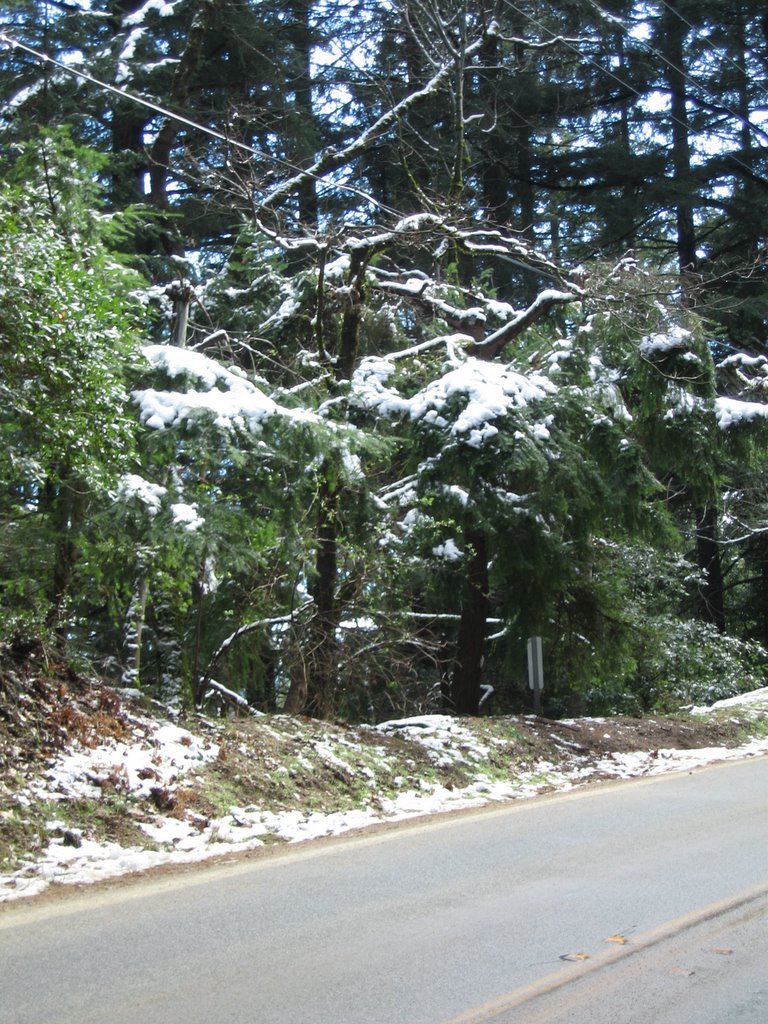 2 days after it snowed, there's still some residual snow in trees on Skyline Blvd near Castle Rock State Park. It was cold, with crackling sounds filling the air as the clumps of snow disintegrated as it melted, dropping pieces of ice onto the road. The road was moist and gritty with all the dirt stuck to the pieces of snow, but there wasn't any ice.
Sunday, February 19, 2006
Those fluffy things are called clouds...
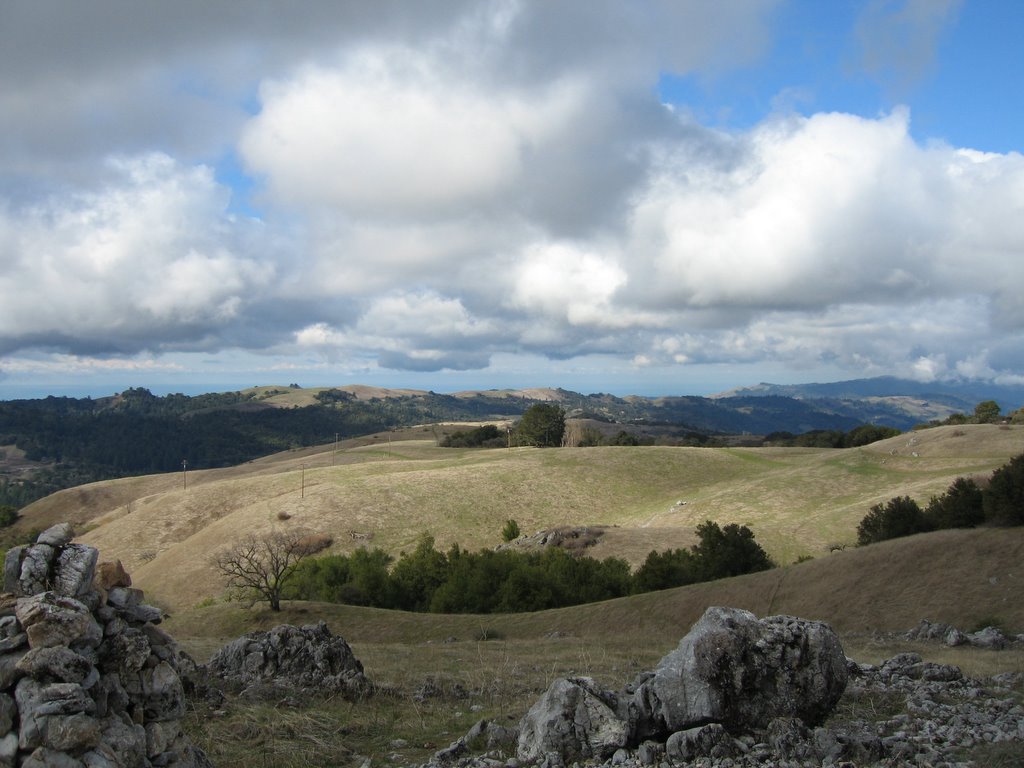 We don't usually see them in Northen California when it's not just pouring on us, so it was indeed a rare day.
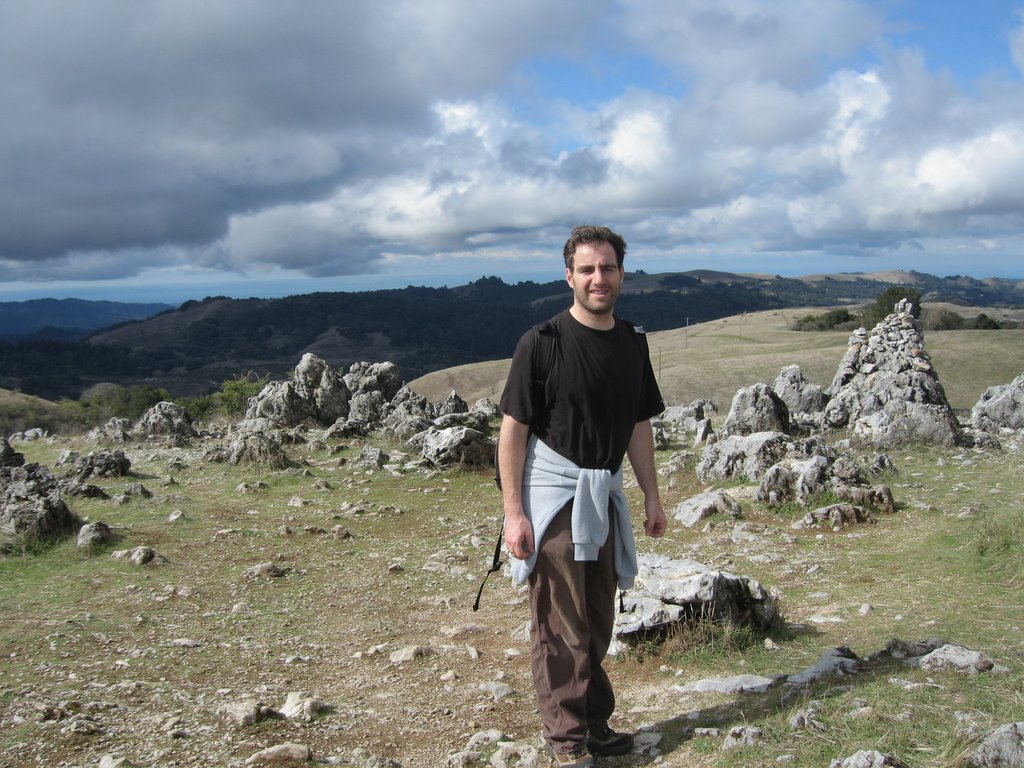
Snow on Black Mountain
 It snowed the last couple of days, so I had to climb Black Mountain to see if I could see some snow.
Monday, February 13, 2006
Einstein's Dreams
This is a cute little short book about time. It's a novella full of little montages about alternate realities where time is somehow different. People who know a little bit about the Theory of Relativity will understand the references to special circumstances where time does behave differently, even in our universe (near a large gravity well, at high velocity, etc), but those are merely references, not allegories.
The writing style is light, almost whimsical, and the chapters short and easy to read:
In this world, it is instantly obvious that something is odd. No houses can be seen in the valleys or plains. Everyone lives in the mountains.
At some time in the past, scientists discovered that time flows more sloowly the farther from the center of the earth. The effect is minuscule, but it can be measured with extremely sensitive instruments. Once the phenomenon was known, a few people, anxious to stay young, moved to the mountains. Now all houses are built on Dom, the Matterhorn, Monte Rosa, and other high ground. It is impossible to sell living quarters elsewhere...
This book is recommended as a light read.
The writing style is light, almost whimsical, and the chapters short and easy to read:
In this world, it is instantly obvious that something is odd. No houses can be seen in the valleys or plains. Everyone lives in the mountains.
At some time in the past, scientists discovered that time flows more sloowly the farther from the center of the earth. The effect is minuscule, but it can be measured with extremely sensitive instruments. Once the phenomenon was known, a few people, anxious to stay young, moved to the mountains. Now all houses are built on Dom, the Matterhorn, Monte Rosa, and other high ground. It is impossible to sell living quarters elsewhere...
This book is recommended as a light read.
Sunday, February 12, 2006
Ammonite, by Nicola Griffith
This book is not science fiction. First of all, a virus that kills all the men and only 20% of the women is scientifically implausible. That the same virus might give all surivors access to a collective Jungian unconscious is even more implausible. The last straw came when I read the author's afterword at the end of the book:
Women are not aliens. Take away men and we do not automatically lose our fire and intelligence and sex drive...
As far as I could tell, only aliens could have lived on the planet that Griffith describes: there's no easily accessible medical technology, yet every woman survives childbirth. The "men's world" of technology (referred to as The Company)is equally implausible --- despite great scientific advances (ability to manipulate DNA that can create a vaccine without access to an actual viral sample), they are unable to disinfect returnees or provide advanced medical help better than a splint?
As a fantasy, this book fails as well. The protagonist does boneheaded things that in any sane world would have resulted in death or worse. She makes decisions that binds her cohorts and colleagues without consulting them, and then expects them to agree to be bound by them, and in general behaves like a total dick.
All in all, that such a book won the Tiptree Award while David Brin's Glory Season was denied it will lead me to ignore the Tiptree Award in the future as a possible signal for the goodness of a novel. Brin's comments as such appear as a text file here. Download by using "save as" and view using emacs.
Women are not aliens. Take away men and we do not automatically lose our fire and intelligence and sex drive...
As far as I could tell, only aliens could have lived on the planet that Griffith describes: there's no easily accessible medical technology, yet every woman survives childbirth. The "men's world" of technology (referred to as The Company)is equally implausible --- despite great scientific advances (ability to manipulate DNA that can create a vaccine without access to an actual viral sample), they are unable to disinfect returnees or provide advanced medical help better than a splint?
As a fantasy, this book fails as well. The protagonist does boneheaded things that in any sane world would have resulted in death or worse. She makes decisions that binds her cohorts and colleagues without consulting them, and then expects them to agree to be bound by them, and in general behaves like a total dick.
All in all, that such a book won the Tiptree Award while David Brin's Glory Season was denied it will lead me to ignore the Tiptree Award in the future as a possible signal for the goodness of a novel. Brin's comments as such appear as a text file here. Download by using "save as" and view using emacs.
Saturday, February 11, 2006


Subscribe to:
Comments (Atom)


