I wanted to see if there was any snow left on Skyline, two days after a once a decade snowfall in the Bay Area. I climbed Pierce Road and Highway 9 with no trouble, seeing no other cyclists except a mountain biker on Pierce Road who turned off towards the reservoir. The amount of car traffic was considerable, however, indicating that many folks had the same idea I did. The weather was warm, prompting thoughts that the snow might all be gone already.
A left turn on Skyline Blvd brought further climbing and the temperature rapidly dropped under the shade of pine trees. I stopped at an open space to check out the visibility --- unfortunately, it was not clear to the coast --- a light haze filled the air and I could not see the Big Sur coastline hidden in the clouds.
As I approached Castle Rock State Park, I started seeing patches of residual ice on the roadside. The road surface became sandy and grimy and quite wet. As I approached Castle Rock, I observed that the parking lot was full. Sure enough, there were kids throwing snowballs at each other! The tree branches above me were still laden with snow, the melting of which caused droplets of water to fall on the road (and on me). There was a crackling in the air as pieces of ice broke off from the snow clumps and landed onto the road. I stopped for a couple of pictures and then moved on.
Past Castle Rock, the road began a rapid descent, but out of the corner of my eye, I could see that the Christmas Tree farm along Skyline was inundated with snow in its open spots. The descent on Skyline is normally enjoyable and fast, but with the road surface dark and wet, I did not want to risk running over any black-ice and kept my speed down. About a mile from the Black road intersection all traces of ice and snow went away and I could relax again and enjoy the open scenery all around me.
Past Black road, Skyline Blvd becomes a one lane road that has relatively light traffic but many blind corners, which I took prudently despite the lack of motor-traffic since Castle Rock. The reason for this lack of traffic became apparently when I ran up to a "Road Closed" sign. It looked like a minor bit of construction, so I walked my bike around the sign and through the construction. The construction was muddy, and some small stones got wedged in between my brakes and the rim, but a bit of extra water and a stick used as a scraper solved that problem.
Except for an unusual amount of traffic down Bear Creek road, the rest of the ride was uneventful.
Monday, February 20, 2006


Snow on Skyline Blvd
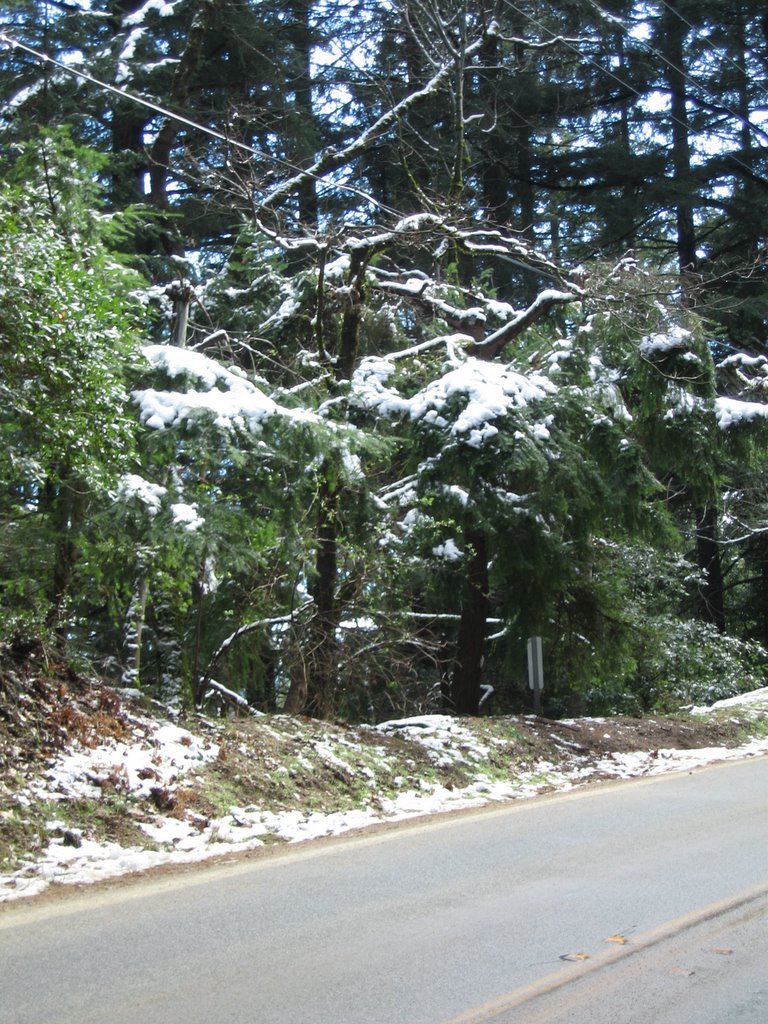 2 days after it snowed, there's still some residual snow in trees on Skyline Blvd near Castle Rock State Park. It was cold, with crackling sounds filling the air as the clumps of snow disintegrated as it melted, dropping pieces of ice onto the road. The road was moist and gritty with all the dirt stuck to the pieces of snow, but there wasn't any ice.
Sunday, February 19, 2006
Those fluffy things are called clouds...
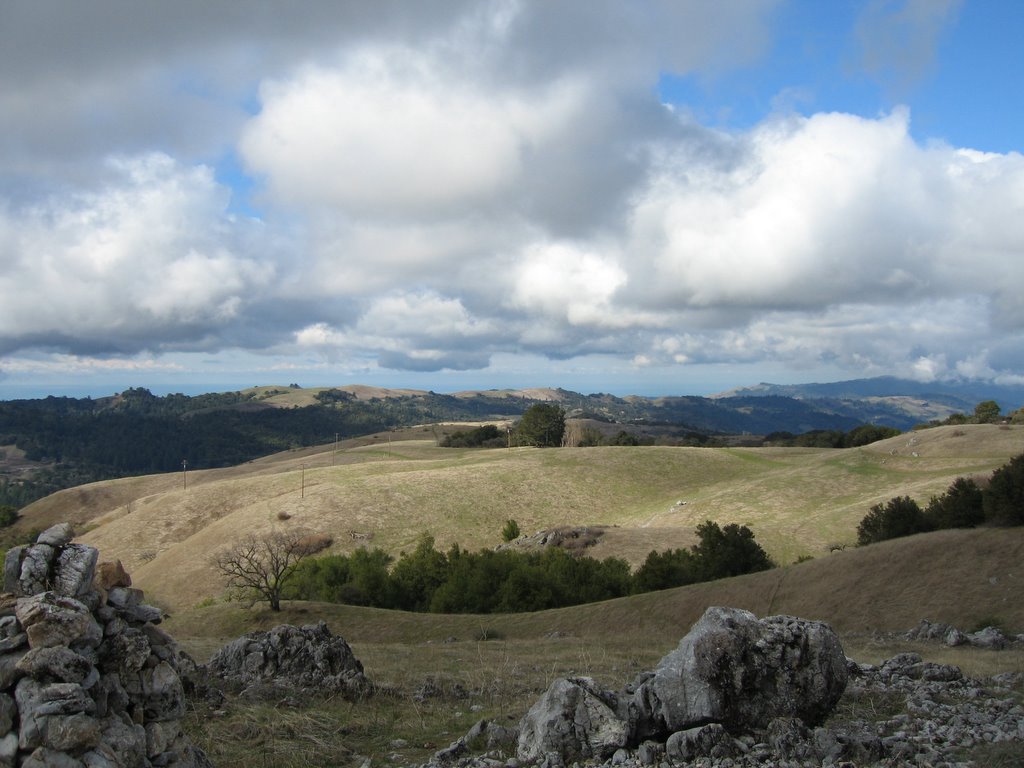 We don't usually see them in Northen California when it's not just pouring on us, so it was indeed a rare day.
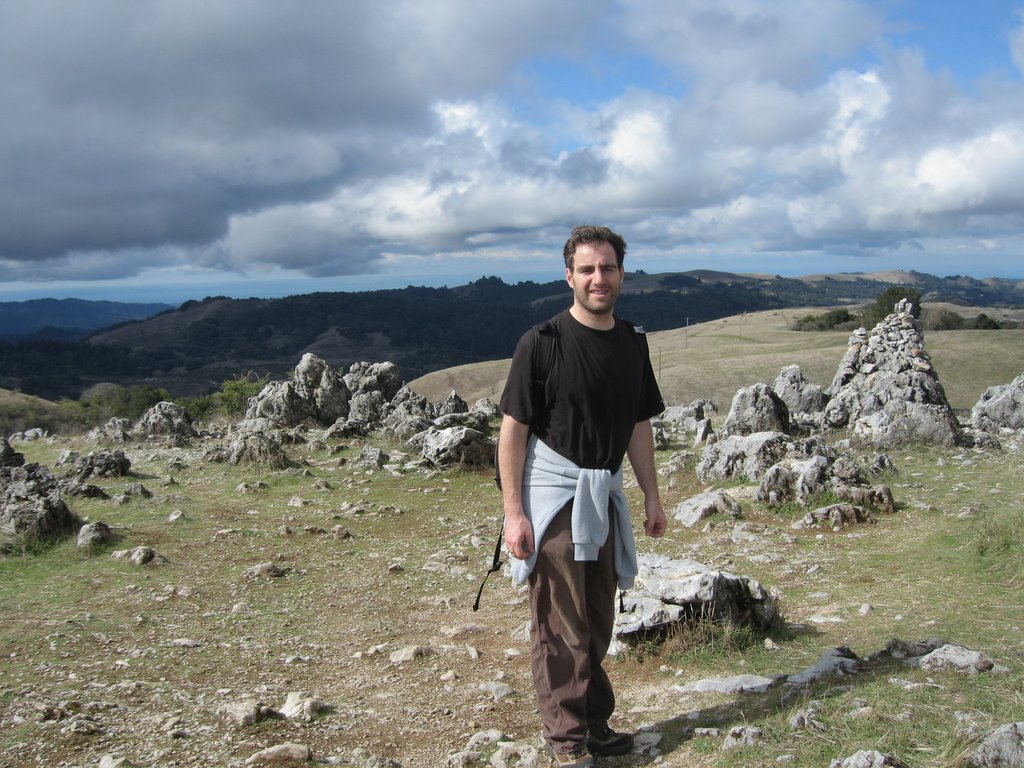
Snow on Black Mountain
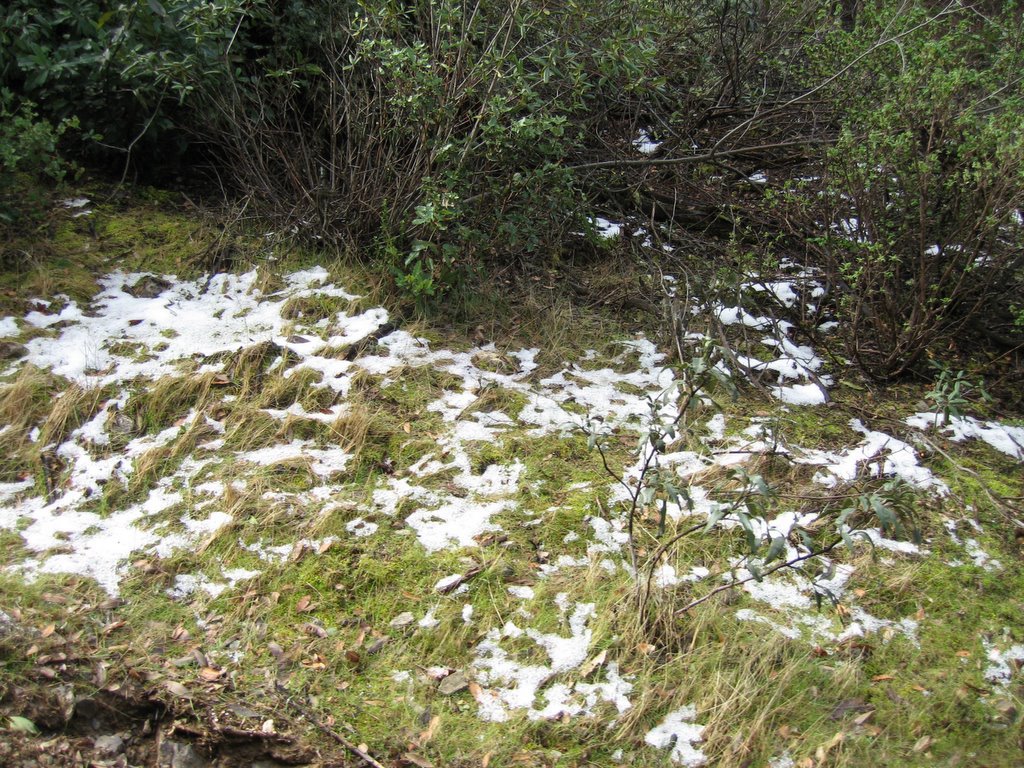 It snowed the last couple of days, so I had to climb Black Mountain to see if I could see some snow.
Monday, February 13, 2006
Einstein's Dreams
This is a cute little short book about time. It's a novella full of little montages about alternate realities where time is somehow different. People who know a little bit about the Theory of Relativity will understand the references to special circumstances where time does behave differently, even in our universe (near a large gravity well, at high velocity, etc), but those are merely references, not allegories.
The writing style is light, almost whimsical, and the chapters short and easy to read:
In this world, it is instantly obvious that something is odd. No houses can be seen in the valleys or plains. Everyone lives in the mountains.
At some time in the past, scientists discovered that time flows more sloowly the farther from the center of the earth. The effect is minuscule, but it can be measured with extremely sensitive instruments. Once the phenomenon was known, a few people, anxious to stay young, moved to the mountains. Now all houses are built on Dom, the Matterhorn, Monte Rosa, and other high ground. It is impossible to sell living quarters elsewhere...
This book is recommended as a light read.
The writing style is light, almost whimsical, and the chapters short and easy to read:
In this world, it is instantly obvious that something is odd. No houses can be seen in the valleys or plains. Everyone lives in the mountains.
At some time in the past, scientists discovered that time flows more sloowly the farther from the center of the earth. The effect is minuscule, but it can be measured with extremely sensitive instruments. Once the phenomenon was known, a few people, anxious to stay young, moved to the mountains. Now all houses are built on Dom, the Matterhorn, Monte Rosa, and other high ground. It is impossible to sell living quarters elsewhere...
This book is recommended as a light read.
Sunday, February 12, 2006
Ammonite, by Nicola Griffith
This book is not science fiction. First of all, a virus that kills all the men and only 20% of the women is scientifically implausible. That the same virus might give all surivors access to a collective Jungian unconscious is even more implausible. The last straw came when I read the author's afterword at the end of the book:
Women are not aliens. Take away men and we do not automatically lose our fire and intelligence and sex drive...
As far as I could tell, only aliens could have lived on the planet that Griffith describes: there's no easily accessible medical technology, yet every woman survives childbirth. The "men's world" of technology (referred to as The Company)is equally implausible --- despite great scientific advances (ability to manipulate DNA that can create a vaccine without access to an actual viral sample), they are unable to disinfect returnees or provide advanced medical help better than a splint?
As a fantasy, this book fails as well. The protagonist does boneheaded things that in any sane world would have resulted in death or worse. She makes decisions that binds her cohorts and colleagues without consulting them, and then expects them to agree to be bound by them, and in general behaves like a total dick.
All in all, that such a book won the Tiptree Award while David Brin's Glory Season was denied it will lead me to ignore the Tiptree Award in the future as a possible signal for the goodness of a novel. Brin's comments as such appear as a text file here. Download by using "save as" and view using emacs.
Women are not aliens. Take away men and we do not automatically lose our fire and intelligence and sex drive...
As far as I could tell, only aliens could have lived on the planet that Griffith describes: there's no easily accessible medical technology, yet every woman survives childbirth. The "men's world" of technology (referred to as The Company)is equally implausible --- despite great scientific advances (ability to manipulate DNA that can create a vaccine without access to an actual viral sample), they are unable to disinfect returnees or provide advanced medical help better than a splint?
As a fantasy, this book fails as well. The protagonist does boneheaded things that in any sane world would have resulted in death or worse. She makes decisions that binds her cohorts and colleagues without consulting them, and then expects them to agree to be bound by them, and in general behaves like a total dick.
All in all, that such a book won the Tiptree Award while David Brin's Glory Season was denied it will lead me to ignore the Tiptree Award in the future as a possible signal for the goodness of a novel. Brin's comments as such appear as a text file here. Download by using "save as" and view using emacs.
Saturday, February 11, 2006


Riding along the farmlands of Morgan Hill/Gilroy
 Lisa shot pictures of Bill Bushnell and other cyclists who were hanging around near our tandem.

Route-Sheet Bingo
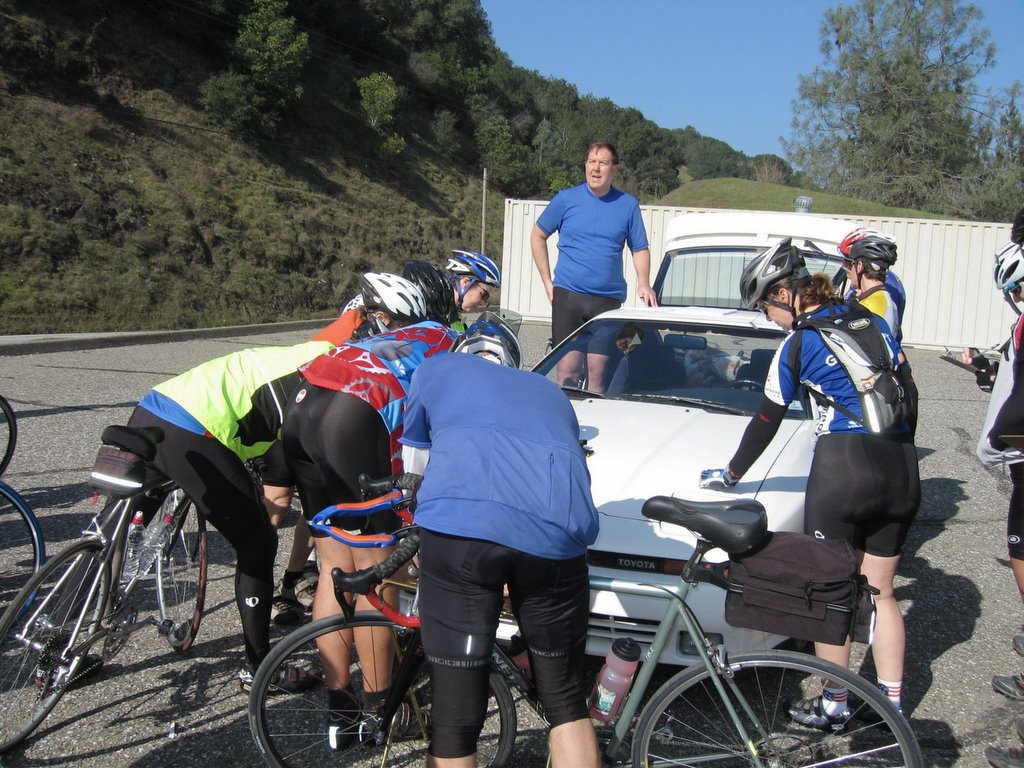 Route sheets were in short supply at the Morgan Hill LDT today, so Mark Marc handed out pen and paper and the Western Wheelers played "Route Sheet Bingo".
Thursday, February 09, 2006
The Merchant Princes Trilogy (parts 1 & 2)
I seem to be reading a lot of Charles Stross lately, and complaining that I didn't like his character development. I also have to stop reading book series where the entire series haven't been published yet (George R. R. Martin, I'm looking at you).
That said, The Family Trade and The Hidden Family demonstrate significant improvements over his earlier works. Stross openly acknowledges his inspiration by Roger Zelazny's Amber Chronicles, which feature a family of world-walkers, people who can travel between parallel Earths through the use of a pattern.
Stross does Zelazny one step better, however, by extrapolating what would happen if a family which didn't have supernatural powers actually did exist, and set out to exploit this ability to gain secular power and wealth. He uses the trick of having the heroine of the story be someone who was unaware of her family's existence stumbling into her heritage as a Duchess, and executed a very well-done play on the "adopted princess" fantasy trope, complete with the "princess" realizing that being stuck in a medieval world just isn't very much fun.
The action in the novels move fast and furiously, with little pieces of exposition thrown in that aren't too awkward. The heroine, unlike many fantasy heroines, isn't one of those people whom you just want to grab by the scruff of their collars and shake, is sensible and intelligent, and does what a smart, well-educated person would do in her position (she's just a little bit tougher than your average person, but not any more unbelievable than Veronica Mars was).
Once the action starts, I found the books hard to put down, and to be fair to Stross, even though its a trilogy, you won't come to the end of the second book feeling cheated even though the ending is yet to be written.
Recommended.
That said, The Family Trade and The Hidden Family demonstrate significant improvements over his earlier works. Stross openly acknowledges his inspiration by Roger Zelazny's Amber Chronicles, which feature a family of world-walkers, people who can travel between parallel Earths through the use of a pattern.
Stross does Zelazny one step better, however, by extrapolating what would happen if a family which didn't have supernatural powers actually did exist, and set out to exploit this ability to gain secular power and wealth. He uses the trick of having the heroine of the story be someone who was unaware of her family's existence stumbling into her heritage as a Duchess, and executed a very well-done play on the "adopted princess" fantasy trope, complete with the "princess" realizing that being stuck in a medieval world just isn't very much fun.
The action in the novels move fast and furiously, with little pieces of exposition thrown in that aren't too awkward. The heroine, unlike many fantasy heroines, isn't one of those people whom you just want to grab by the scruff of their collars and shake, is sensible and intelligent, and does what a smart, well-educated person would do in her position (she's just a little bit tougher than your average person, but not any more unbelievable than Veronica Mars was).
Once the action starts, I found the books hard to put down, and to be fair to Stross, even though its a trilogy, you won't come to the end of the second book feeling cheated even though the ending is yet to be written.
Recommended.
Monday, February 06, 2006
West Old La Honda Road on Saturday
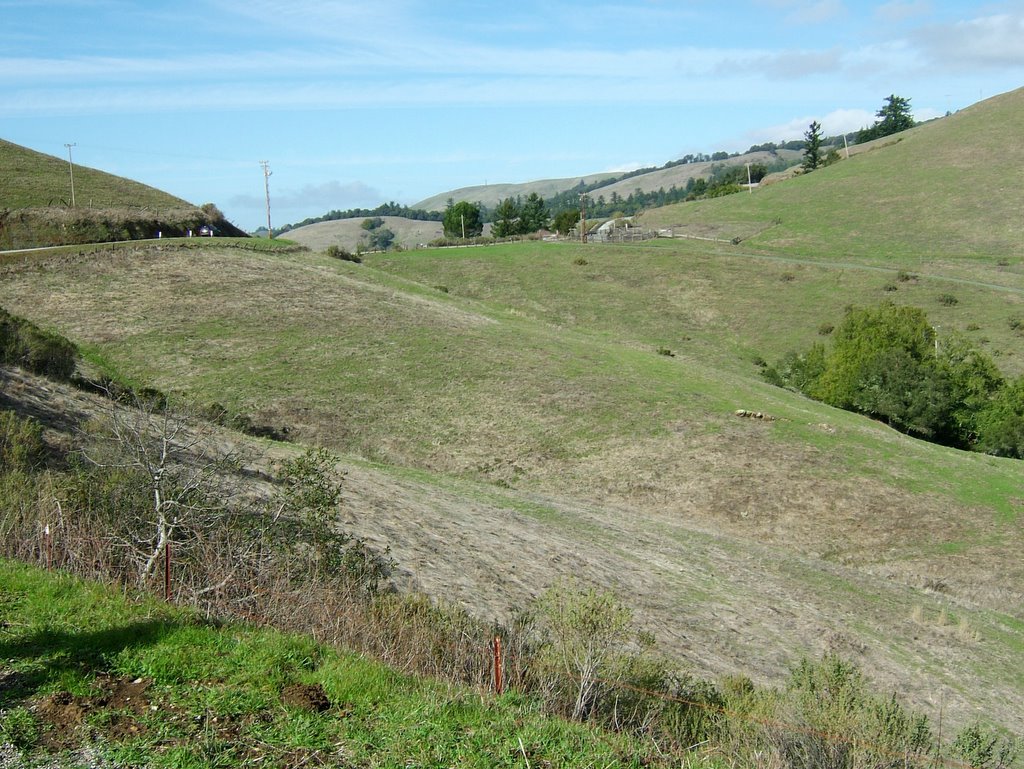 Winter riding in the Bay Area: lush green hills, beautiful weather, and lovely lovely roads. Photo Credit: Roberto Peon
Sunday, February 05, 2006


Saturday, February 04, 2006
Review: Coraline
Scarlet considers this one of her two best books of 2005, so I checked it out of the library and read it. It's not a bad book by any means, but I don't think it's anything special. It's definitely not even in the same class as StarDust, which I consider to be the best of Gaiman's prose works (by the way, buy the one with Charles Vess illustrations, which is the way the book was published --- the "words only" version are for snotty people who don't think that comic books can't be considered literature).
The horror I find to be rather pedestrian, but then again, I don't think I was ever the kind of kid (or now, adult) who could be horrified or scared by words on a page --- visual horror can terrify me, but not novels or books. The real horror in the book, for me, is the portrait of a child thoroughly neglected by her parents. I guess I can be grateful that my parents always found time to play with me, and gave me such imaginative tools and toys in my mind that I was never ever bored, either as an adult or as a child.
Anyway, it's a short book, so it's not a waste of time.
The horror I find to be rather pedestrian, but then again, I don't think I was ever the kind of kid (or now, adult) who could be horrified or scared by words on a page --- visual horror can terrify me, but not novels or books. The real horror in the book, for me, is the portrait of a child thoroughly neglected by her parents. I guess I can be grateful that my parents always found time to play with me, and gave me such imaginative tools and toys in my mind that I was never ever bored, either as an adult or as a child.
Anyway, it's a short book, so it's not a waste of time.
Friday, February 03, 2006
Two interesting articles in this week's New Yorker
First, there's a Book Review of The Man Who Knew Too Much, a biography of Alan Turing that doesn't sound like it's worth reading. However, the review provides a nice, condensed summary of Turing's life that's very much worth reading. The definitive book on Turing is Alan Turing: Enigma, which I read a while ago and remember as being quite good.
The second great article is an article by Malcolm Gladwell about Profiling. It busts the typical myths about profiling, and uses excellent journalistic technique to illustrate his point. I subscribed to The New Yorker on the basis of Gladwell's visit to Google, and if only every issue was like this one I'd feel like I got my money's worth.
Of course, what annoys me is that we don't have a magazine even half as good as The New Yorker here in the Bay Area. We get crappy stuff like Gentry Magazine, a magazine for people who worship wealth and its privileges, and Sunset Magazine, a vapid lifestyle magazine with no depth. Ah well. In exchange we get good weather and a fabulous outdoor life. Now, if only my copy of the Rivendell Reader would just show up! Now that's a magazine I'm proud to have contributed to, and one that could only exist in the San Francisco Bay Area.
The second great article is an article by Malcolm Gladwell about Profiling. It busts the typical myths about profiling, and uses excellent journalistic technique to illustrate his point. I subscribed to The New Yorker on the basis of Gladwell's visit to Google, and if only every issue was like this one I'd feel like I got my money's worth.
Of course, what annoys me is that we don't have a magazine even half as good as The New Yorker here in the Bay Area. We get crappy stuff like Gentry Magazine, a magazine for people who worship wealth and its privileges, and Sunset Magazine, a vapid lifestyle magazine with no depth. Ah well. In exchange we get good weather and a fabulous outdoor life. Now, if only my copy of the Rivendell Reader would just show up! Now that's a magazine I'm proud to have contributed to, and one that could only exist in the San Francisco Bay Area.
Subscribe to:
Comments (Atom)


